
The accident injury statute of limitations is the legally mandated deadline by which you must file a personal injury lawsuit after being hurt in an accident. Miss it, and a court will dismiss your case regardless of how strong your evidence is. Personal injury deadlines typically range from 1 to 6 years depending on your state, with the clock usually starting on the date of your injury. Two legal tools, the discovery rule and tolling, can shift that clock in specific situations. Knowing exactly where you stand on the timeline is the single most important step you can take after an accident.
What is the accident injury statute of limitations?
The statute of limitations for personal injury claims is a state law that sets a hard deadline for filing a lawsuit. Think of it as a countdown timer that starts the moment you are injured. Once it expires, your right to sue is gone. Courts do not grant extensions simply because your injuries were severe or your medical bills were high.
Most states use a 2-year deadline for personal injury claims, though the full range across the U.S. runs from 1 year to 6 years. That spread matters because a victim injured in Louisiana faces a 1-year window while someone injured in Maine has up to 6 years. Filing in the wrong state's timeframe, or simply not knowing your state's rule, can cost you everything.

The standard term used by courts and attorneys is "statute of limitations." You may also hear "filing deadline," "claim deadline," or "accident injury time limits" used informally. All refer to the same legal concept. The formal term is what judges and defense attorneys will use, so understanding it is critical.
How long do you have to file an injury claim after an accident?
The answer depends on your state, the type of claim, and who you are suing. Here is a breakdown of the most common scenarios.
| Claim Type | Typical Deadline | Notes |
|---|---|---|
| General personal injury | 2 years (most states) | Starts on injury date |
| Medical malpractice | 2 to 3 years | Often uses discovery rule |
| Wrongful death | 1 to 3 years | Starts on date of death |
| Claims against government | 60 to 180 days (notice) | Separate notice requirement |
| Injuries to minors | Tolled until age 18 | Then standard window applies |
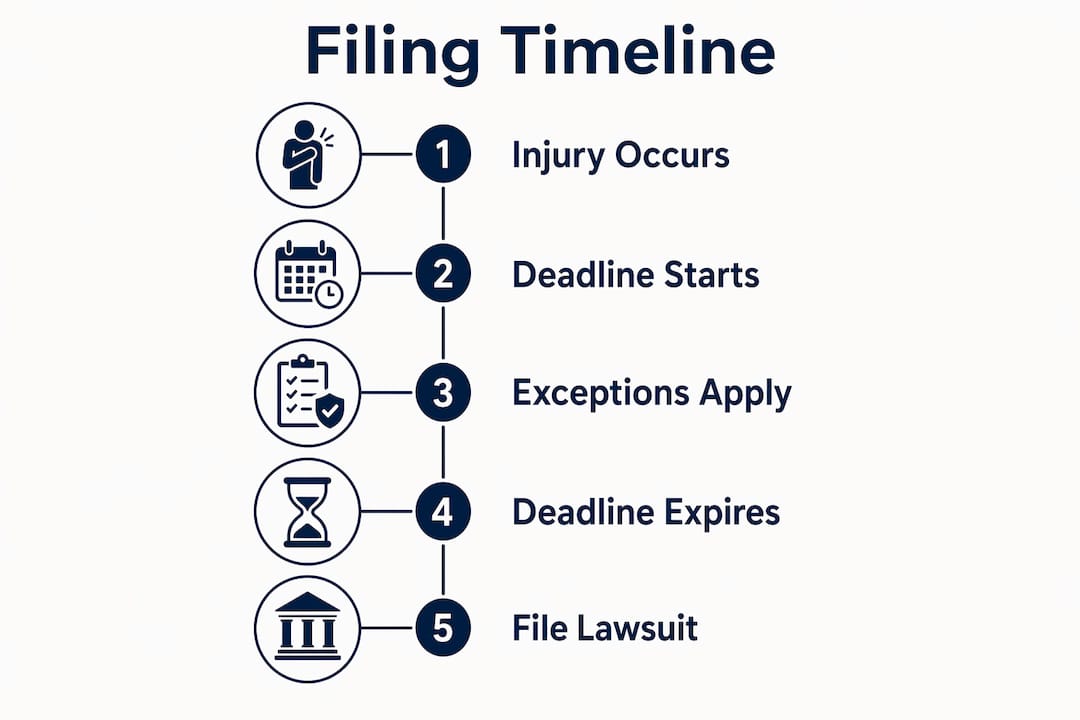
The injury date is the default starting point for the accident claim deadline clock. If you were hurt in a car accident on March 1, 2024, and your state has a 2-year limit, you generally have until March 1, 2026 to file a lawsuit. That date is firm.
Medical malpractice and toxic exposure cases are different. In those situations, you may not realize you were harmed until months or years later. The discovery rule delays the clock start until the injury is discovered or reasonably should have been discovered. This is a critical protection for victims of latent harm.
Wrongful death claims follow their own timeline, typically starting from the date of death rather than the original injury date. If a loved one died weeks after an accident, that distinction changes your filing window. Check your state's specific rules or use a resource like the state-by-state deadline guide on the WreckMatch blog for exact figures.
Pro Tip: Do not assume your state uses the 2-year standard. States like Kentucky and North Dakota allow 4 years, while Tennessee gives you only 1 year. Confirm your deadline before you do anything else.
What exceptions can extend or pause the statute of limitations?
Several legal exceptions can pause or extend your filing window. These are called "tolling" provisions. They do not apply automatically. You must claim them and back them up with evidence.
Here are the most common tolling exceptions:
- Minor plaintiffs. Most states toll the statute while the injured person is under 18. The countdown starts when they turn 18, then the standard window applies. A child injured at age 10 in a 2-year state typically has until age 20 to file.
- Mental incapacity. If the victim is mentally incapacitated at the time of injury, the clock may pause until capacity is restored. Documentation from a licensed medical professional is required.
- Defendant's absence from the state. If the person you are suing leaves the state after the accident, some jurisdictions pause the clock during their absence. This prevents defendants from running out the clock by relocating.
- Fraudulent concealment. If the defendant actively hid their wrongdoing, such as a manufacturer concealing a product defect, courts may extend the deadline from the point the fraud was discovered.
- Discovery rule. As noted above, the clock starts when you knew or reasonably should have known about the injury. This is most common in medical malpractice and toxic exposure cases.
Tolling exceptions require legal documentation and are not automatic. Courts expect formal claims supported by evidence. An attorney must identify which exceptions apply to your case and build the argument for them.
Pro Tip: Never assume a tolling exception applies to your situation without speaking to a personal injury attorney first. Claiming an exception incorrectly can still result in dismissal.
How do statute of limitations deadlines differ when suing government entities?
Suing a city, county, state agency, or federal entity involves a completely separate set of rules. The process is two steps, and the first step has a much shorter deadline than the general personal injury statute.
- File a notice of claim. Before you can sue a government body, you must file a formal notice of claim. This document notifies the agency of your injury, the circumstances, and your intent to seek compensation.
- Meet the notice deadline. Government notice windows run from 60 to 180 days after the injury, depending on the jurisdiction. California, for example, requires a government tort claim within 6 months. New York City requires notice within 90 days.
- Wait for a response. The government entity typically has a set period to respond or reject your claim. Only after that process can you file a lawsuit.
- File the lawsuit within the statutory window. Even after completing the notice process, you must still file your lawsuit within the applicable statute of limitations.
Missing the notice deadline bars the lawsuit entirely, regardless of how serious your injuries are or how clear the government's fault may be. This is one of the most unforgiving rules in personal injury law. If your accident involved a government vehicle, a pothole on a public road, or a slip on government property, treat the notice deadline as your primary deadline. Consult an attorney within days of the accident, not weeks.
What happens if you miss the accident injury statute of limitations?
Missing the filing deadline has one outcome in almost every case: your lawsuit is dismissed.
"Courts dismiss over 90% of late-filed personal injury lawsuits that do not qualify for exceptions. Dismissal is with prejudice, meaning you cannot refile."
The defendant's attorney raises the expired deadline as an affirmative defense. Once raised, dismissal is nearly automatic and final. The judge does not weigh the merits of your case. The strength of your evidence, the severity of your injuries, and the clarity of the other party's fault become irrelevant.
Missing the deadline also destroys your leverage in settlement negotiations. Insurance companies track filing deadlines closely. Once yours passes, they have no legal pressure to offer you anything. Settlements that might have been worth tens of thousands of dollars drop to zero the moment the clock runs out.
There is no grace period in most states. Courts do not accept "I didn't know" as a reason to reopen a dismissed case. The rare exceptions, such as a defendant who fraudulently concealed their identity, require extensive legal proof and are not guaranteed to succeed.
How can you protect your right to file and not miss your deadline?
Protecting your claim starts the day of the accident. Here is what to do:
- Document everything immediately. Take photos at the scene, collect witness contact information, and request a copy of the police report. This evidence supports your claim and helps establish the injury date.
- Seek medical attention right away. A medical record dated close to the accident date is one of the strongest pieces of evidence you have. Delayed treatment creates gaps that defense attorneys exploit.
- Do not rely on insurance negotiations. Filing insurance claims or entering settlement talks does not pause the statute of limitations clock. Your legal deadline runs independently of any insurance process.
- Confirm your state's specific deadline. Use a resource like the car accident claim timeline guide to understand your exact window.
- Consult a personal injury attorney early. An attorney can identify your exact deadline, flag any applicable exceptions, and file your lawsuit before time runs out.
Pro Tip: Set a calendar reminder for 6 months before your deadline. That gives you time to find an attorney, gather records, and file without rushing.
The file injury lawsuit timeline varies by state and claim type, but the one constant is this: earlier is always better. Waiting until the last few weeks before a deadline creates unnecessary risk and limits your attorney's ability to build a strong case.
Key takeaways
The accident injury statute of limitations is a hard legal deadline. Missing it ends your right to compensation, regardless of fault or injury severity.
| Point | Details |
|---|---|
| Standard deadline range | Most states set a 2-year limit, but windows range from 1 to 6 years nationwide. |
| Clock start date | The deadline typically starts on the injury date, not when you hire an attorney. |
| Tolling exceptions exist | Minors, mental incapacity, and fraud can pause the clock, but require legal proof. |
| Government claims are shorter | Notice of claim deadlines run 60 to 180 days, far shorter than standard limits. |
| Insurance talks don't pause the clock | Settlement negotiations run parallel to the legal deadline, not instead of it. |
Why I think most accident victims underestimate this deadline
I have seen the same mistake repeated constantly. Someone gets hurt, they start dealing with insurance adjusters, they assume the legal process is on hold while negotiations happen, and then they call an attorney three weeks before their deadline. At that point, the attorney is scrambling to file a protective lawsuit while simultaneously trying to understand a case they just heard about.
The discovery rule gives people a false sense of security in standard accident cases. That rule was designed for latent injuries, not for someone who knows they were hurt in a car wreck. If you felt pain at the scene, the clock started that day. The discovery rule will not save you.
What I find most frustrating is the government claims situation. Victims injured on public property or by government vehicles often have no idea a 90-day notice window exists. By the time they realize it, the window is closed. No amount of legal skill recovers a missed government notice deadline in most jurisdictions.
My honest advice: treat the statute of limitations like a tax deadline. It does not care about your circumstances. It does not care that you were in the hospital. It does not care that you were dealing with grief. File first, negotiate second. An attorney can always withdraw a lawsuit if a settlement is reached. They cannot undo a missed deadline.
— Scott
Get matched with a personal injury attorney today

If you were injured in an accident, the clock on your claim is already running. WreckMatch connects injured victims with experienced personal injury attorneys quickly and at no upfront cost. Most attorneys in the WreckMatch network work on a contingency fee basis, meaning you pay nothing unless you win. Use the free legal help service to get matched in minutes. If you need state-specific guidance, the accident legal glossary and state help pages at WreckMatch States break down your options clearly. Do not wait until your deadline is days away.
FAQ
What is the statute of limitations for personal injury claims?
The statute of limitations for personal injury claims is a state law deadline for filing a lawsuit after an injury. Most states set a 2-year limit, though the range runs from 1 to 6 years depending on the state and claim type.
Does the discovery rule apply to car accident injuries?
The discovery rule typically applies to latent injuries where harm was not immediately apparent, such as in medical malpractice or toxic exposure cases. For standard car accident injuries where harm was obvious at the scene, courts generally start the clock on the accident date.
Can a minor file a personal injury claim after turning 18?
Yes. Most states toll the statute while a plaintiff is under 18, meaning the filing window does not start until they reach adulthood. The standard deadline then applies from their 18th birthday.
What happens if I miss the filing deadline?
Courts dismiss late-filed claims with prejudice in the vast majority of cases, meaning you cannot refile. The defendant raises the expired deadline as a defense, and the case ends regardless of the evidence.
Do government injury claims have different deadlines?
Yes. Claims against government entities require a notice of claim within 60 to 180 days of the injury, which is far shorter than standard personal injury deadlines. Missing this notice deadline bars the lawsuit entirely.
Recommended
- Statute of Limitations for Car Accidents by State | WreckMatch Blog | WreckMatch
- How Long Do You Have to File a Car Accident Claim? | WreckMatch Blog | WreckMatch
- Texas Car Accident Statute of Limitations — San Antonio Guide (2026) | WreckMatch Blog | WreckMatch
- Texas Car Accident Statute of Limitations — Houston Guide (2026) | WreckMatch Blog | WreckMatch