
Community legal aid is defined as free or low-cost civil legal assistance provided to income-eligible individuals who cannot afford private attorneys. For accident victims, the role of community legal aid covers insurance disputes, denied claims, benefits access, and consumer protection issues. It does not typically cover personal injury lawsuits, which private attorneys handle on contingency. Understanding this distinction early saves you time and gets you to the right help faster.
Legal aid organizations like Legal Aid of North Carolina and Legal Access For All (Florida) serve as the front line of civil legal support for car, truck, and motorcycle accident victims who face complex paperwork, unresponsive insurers, and tight deadlines. These organizations fill a gap that private attorneys often cannot. Only 23% of low-income serious injury victims obtain legal representation compared to 71% in wealthier areas. That gap is exactly where community legal assistance steps in.
What is the role of community legal aid for accident victims?
Community legal aid focuses on civil legal problems that arise after an accident, not the personal injury lawsuit itself. Think of it as the support system that keeps your claim alive while a private attorney handles the injury damages side, if you have one.
Here is what community legal aid typically covers for accident victims:
- Insurance claim disputes: If your insurer denies, delays, or underpays your claim, legal aid can help you file a formal dispute or appeal.
- Property damage claims: Disputes over vehicle repair costs or total-loss valuations fall squarely within legal aid's scope.
- Consumer protection issues: Deceptive practices by repair shops, towing companies, or insurers can be challenged with legal aid support.
- Benefits access: Accidents often disrupt employment, housing, and disability benefits. Legal aid helps you apply for or appeal those benefits.
- Medical billing disputes: Surprise bills, billing errors, and coverage denials from health insurers are common post-accident problems legal aid addresses.
What legal aid does not typically cover is the personal injury lawsuit itself. If you were injured in a truck or car accident and want to pursue damages for pain, suffering, or lost wages, a private personal injury attorney working on contingency is the right path. Legal aid and private attorneys serve different functions, and knowing which one you need prevents wasted time.
Pro Tip: If your insurer denies your claim, contact a legal aid helpline before accepting any settlement offer. Reviewing your denial letter with a legal aid attorney costs nothing and could reveal grounds for a successful appeal.
How do accident victims access community legal aid?
The intake process at most community legal aid organizations follows a clear sequence. Knowing the steps before you call saves time and reduces stress.
- Call the helpline or submit an online intake form. Legal Access For All in Florida accepts both phone appointments and online submissions. If you have a court date within roughly two weeks, call the helpline directly rather than submitting a form. Urgent cases require immediate helpline contact to avoid missed deadlines.
- Complete eligibility screening. Eligibility is based on income level and case type. Most programs serve households below 125% to 200% of the federal poverty line. Some offer free screening regardless of income.
- Receive an attorney callback. After screening, a staff attorney reviews your situation and provides focused legal advice. Legal Access For All assists more than 14,000 callers annually through this model, which shows the scale of need and the system's capacity to respond.
- Get referred or represented. Depending on your case complexity, you may receive a referral to a full-service legal aid office, a pro bono attorney, or a community advocate.
Eligibility varies by state and organization. Legal Aid of North Carolina, for example, screens for both income and case type before accepting representation. Some organizations like Sound Legal Aid in Washington provide advice and community education to over 100,000 people annually facing poverty-related legal issues, including accident cases.
Pro Tip: Gather your police report, insurance denial letters, and any medical bills before your intake call. Attorneys can give you more specific advice when you have documents in hand.

Why legal aid matters beyond the injury claim
The role of legal aid extends well past filling out forms. Community legal assistance functions as civic infrastructure that connects accident victims to a wider network of support.
"Advocates serve as a critical link between accident victims and the legal system, connecting them not only to attorneys but also to counseling, emergency financial aid, and community resources that ease the path to justice." — Parle Magazine
This coordination matters because accidents disrupt every part of a person's life at once. You may lose income, face eviction, need mental health support, and fight an insurer simultaneously. Legal aid organizations recognize this reality and often partner with social service agencies to address all of it together.
The systemic barriers are real and documented:
- Legal deserts: Many rural counties have no legal aid office within a reasonable distance, leaving victims without any civil legal support.
- Low awareness: Lack of early legal information at hospitals and police stations leaves many accident victims unaware that free help exists at all.
- Geographic disparities: Urban victims have far more access to legal aid clinics, pro bono networks, and courthouse self-help centers than rural victims do.
- Language barriers: Non-English-speaking victims face additional screening and communication challenges that reduce their access to services.
Advocacy organizations address these gaps through hospital outreach programs, courthouse clinics, and partnerships with police departments to distribute legal rights information at the scene of accidents. Combining legal aid with community care coordination helps victims maintain evidence quality and claim continuity, two factors that directly affect compensation outcomes.
Community legal aid vs. private personal injury attorneys
Understanding the difference between these two types of legal help prevents a common and costly mistake: calling the wrong one first.
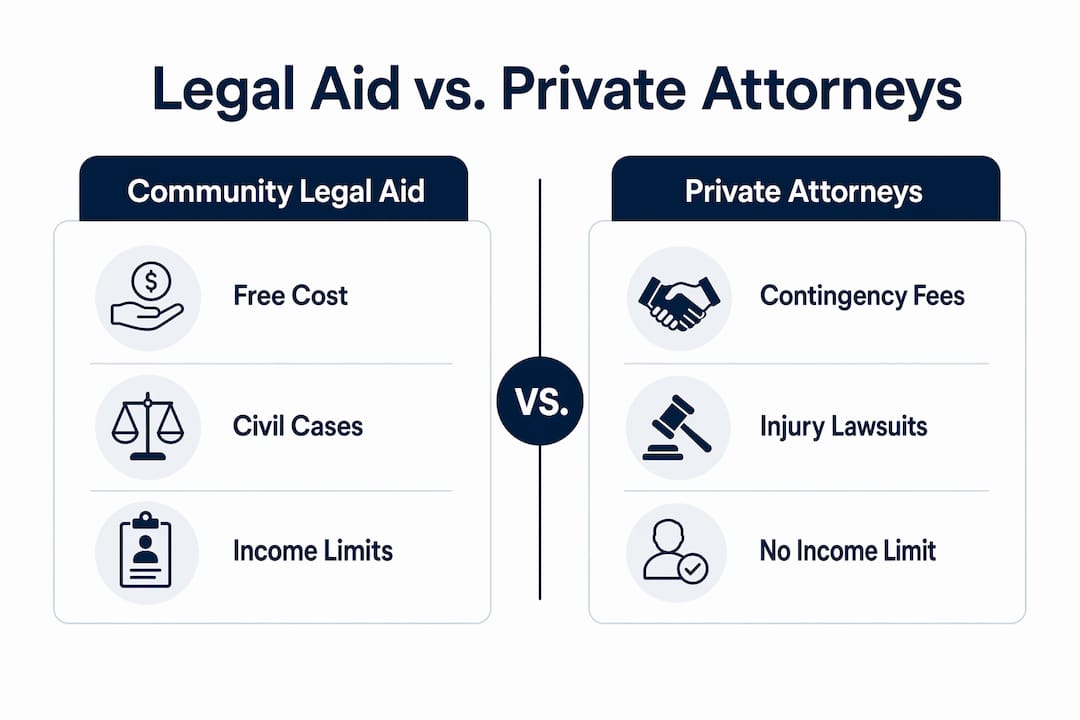
| Factor | Community legal aid | Private personal injury attorney |
|---|---|---|
| Cost | Free or low-cost for eligible clients | Contingency fee (typically 33%–40% of settlement) |
| Case type | Insurance disputes, benefits, civil issues | Injury claims, pain and suffering, lost wages |
| Income requirement | Yes, income-based eligibility | No income requirement |
| Speed for civil disputes | Faster for coverage and billing issues | Slower; focused on injury damages |
| Personal injury lawsuits | Generally not handled | Primary focus |
Community legal aid steps in for civil disputes that are not economically viable for contingency-based personal injury lawyers. A private attorney working on contingency needs a case with significant injury damages to justify their time. A $3,000 insurance underpayment dispute is not worth their fee structure, but it is exactly what legal aid handles well.
The two types of help are not competing. They are complementary. You can work with a private attorney on your injury claim while simultaneously using legal aid to fight a denied health insurance appeal or resolve a property damage dispute. For minor property damage under your state's small claims court threshold (typically $5,000 to $10,000), you may not need either. Small claims court is designed for self-representation and costs very little to file.
Practical steps to maximize your legal aid benefits
Getting the most from community legal assistance requires preparation and timing. Here is what to do before and during your engagement with legal aid:
- Preserve all documentation immediately. Collect your police report, photos of the scene, medical records, insurance correspondence, and repair estimates. Maintaining quality documentation is the single most important factor in keeping your claim valid and progressing.
- Know your deadlines. Statutes of limitations and insurance appeal windows vary by state. Missing a deadline can permanently bar your claim. Ask your legal aid attorney about all applicable deadlines on your first call.
- Use free legal clinics. Many bar associations and law schools run free walk-in clinics where you can get a quick case review before your formal intake appointment.
- Understand your rights. Review resources like the accident legal glossary to learn terms like subrogation, bad faith, and coverage limits before speaking with an attorney.
- Contact legal aid early. The earlier you reach out, the more options you have. Waiting until a court date is imminent limits what any attorney can do for you.
- Ask about referrals. If your case falls outside legal aid's scope, ask for a referral to a pro bono attorney, a law school clinic, or a private attorney who handles your type of case.
Victims who seek legal advice after an accident consistently achieve better outcomes than those who navigate the process alone. Early engagement with any form of legal support, whether community legal aid or a private attorney, changes the trajectory of your case.
Key takeaways
Community legal aid is the fastest and most accessible path for accident victims dealing with insurance disputes, benefits denials, and civil legal problems outside the personal injury lawsuit itself.
| Point | Details |
|---|---|
| Scope of legal aid | Legal aid covers insurance disputes, benefits, and civil issues but not personal injury lawsuits. |
| Intake process | Call a helpline or submit an online form; urgent cases with court dates require immediate phone contact. |
| Access gap | Only 23% of low-income injury victims get legal representation versus 71% in wealthier areas. |
| Complementary roles | Legal aid and private personal injury attorneys serve different functions and can work in parallel. |
| Documentation matters | Preserving police reports, medical records, and insurance letters is critical to claim success. |
Why the access gap in legal aid keeps me up at night
I have spent years watching accident victims make the same mistake: they call a personal injury attorney for a $2,500 insurance dispute, get turned down because the case is too small for contingency, and then give up entirely. They assume no help exists. That assumption costs them money, time, and sometimes their housing or employment benefits.
The legal aid system is not perfect. Wait times are real. Geographic coverage is uneven. Many programs are underfunded relative to the demand they face. But the organizations doing this work, Legal Aid of North Carolina, Legal Access For All, Sound Legal Aid, and dozens of others across every state, are genuinely trying to level a playing field that is stacked against low-income victims.
What I find most encouraging is the shift toward coordinated care models. When legal aid organizations partner with hospitals, social workers, and community advocates, victims get help with the full picture: legal, financial, and personal. That is the model that actually works. The victims who engage early, bring their documents, and use every available resource consistently come out ahead.
My honest advice: do not wait. Call a legal aid helpline the week of your accident, not the week before your court date. The system rewards early action, and the help is free.
— Scott
Get free legal help for your accident today
You do not have to figure this out alone. WreckMatch connects accident victims with experienced personal injury attorneys at no upfront cost, in 60 seconds or less.
Whether you were in a car, truck, or motorcycle accident, WreckMatch's free attorney matching service gets you to the right legal help fast. Use the free attorney matching tool to connect with a licensed attorney who handles your type of case. Attend one of WreckMatch's free weekly webinars to understand your rights, claim timelines, and what to expect from the legal process. No fees. No confusion. Just fast, reliable support when you need it most.
FAQ
What does community legal aid cover for accident victims?
Community legal aid covers civil legal issues such as insurance claim disputes, denied benefits, property damage claims, and consumer protection problems. It does not typically handle personal injury lawsuits, which private attorneys manage on a contingency fee basis.
How do I qualify for free legal aid after an accident?
Eligibility is based primarily on income, usually set at 125% to 200% of the federal poverty line, and case type. Some organizations offer free screening to anyone regardless of income to determine whether they qualify for full services.
What should I do if my insurance claim is denied?
Contact a community legal aid helpline immediately and request a review of your denial letter. Legal aid attorneys can identify grounds for appeal and help you file a formal dispute at no cost to you. You can also review the insurance claim denial guide for immediate next steps.
Can I use legal aid and a private attorney at the same time?
Yes. Legal aid handles civil disputes like insurance appeals and benefits denials while a private personal injury attorney pursues your injury damages claim. The two roles do not conflict and often complement each other.
How fast can I get help from a legal aid organization?
Urgent cases with court dates within two weeks are prioritized through direct helpline calls and can receive same-day or next-day attorney guidance. Routine matters typically involve a scheduled phone screening within a few business days.
Recommended
- About Accident Survival Guide | WreckMatch
- Severe Car Accident Injuries: When to Call a Lawyer (2026) | WreckMatch Blog | WreckMatch
- Severe Injury After a Car Accident in Los Angeles, California (2026) | WreckMatch Blog | WreckMatch
- Catastrophic Injury Car Crash in Los Angeles, California (2026) | WreckMatch Blog | WreckMatch