
The moments after a car accident are disorienting. You may be in pain, shocked, and unsure what to say or do. Yet protecting legal rights after an accident starts immediately, not days later. Every choice you make in those first hours, from what you tell the other driver to whether you see a doctor, shapes what happens to your injury claim. This guide breaks down exactly what you need to know, in plain language, so you can act with confidence even when everything feels uncertain.
Table of Contents
- Key Takeaways
- Protecting your legal rights after an accident starts here
- How to talk to insurance companies safely
- Legal deadlines and when to call an attorney
- Victim protections that go beyond compensation
- My honest take on what really protects accident victims
- Get free legal help right now
- FAQ
Key Takeaways
| Point | Details |
|---|---|
| Document everything fast | Photograph the scene, collect witness info, and request a police report before leaving. |
| Skip the recorded statement | You have no legal obligation to give a recorded statement to the other driver's insurer. |
| Know your filing deadline | Personal injury deadlines vary by state and missing one can permanently end your claim. |
| Get medical care immediately | Early medical records are far more credible and harder for insurers to dispute. |
| Consult an attorney early | A personal injury attorney can protect your rights before you make costly mistakes. |
Protecting your legal rights after an accident starts here
Most people think protecting their rights means calling a lawyer the next day. That's too late. The actions you take in the first 30 to 60 minutes set the foundation for your entire claim.
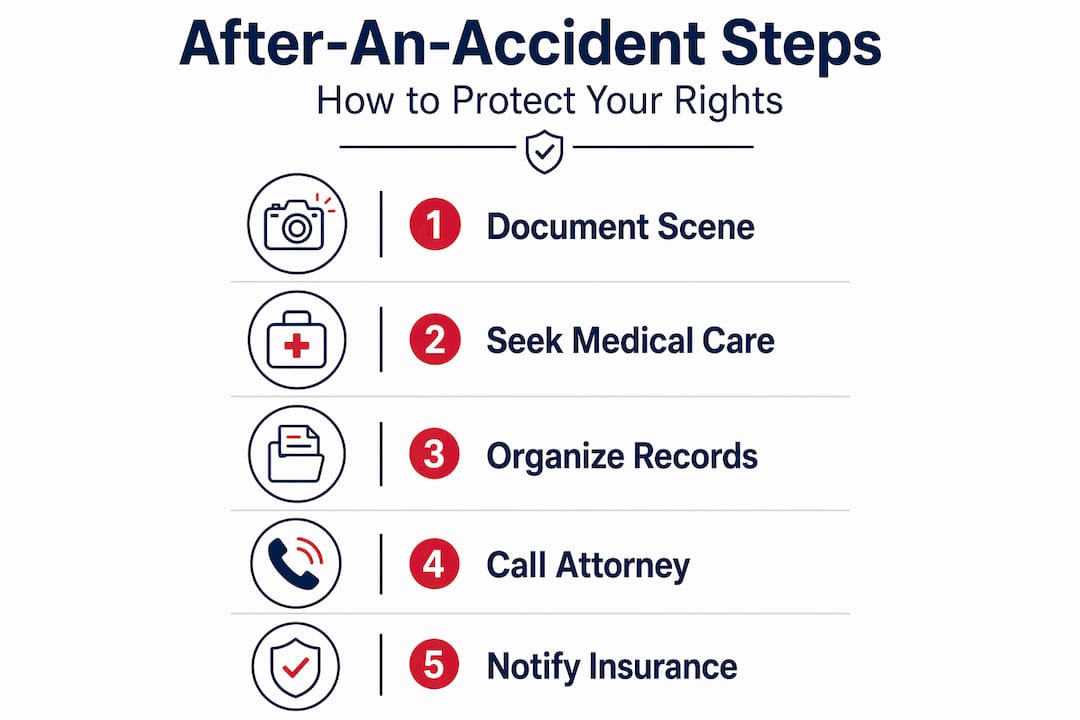
What to do at the scene
Start with the basics and do them in order:
- Call 911. A police report is an official record. Without one, the other driver can later dispute what happened.
- Photograph everything. Get the damage to both vehicles, the road conditions, traffic signs, skid marks, and any visible injuries on your body.
- Collect witness information. Names, phone numbers, and a brief account of what they saw. Witnesses are often gone within minutes.
- Do not admit fault. Even saying "I'm sorry" can be used against you. Stick to exchanging insurance and contact information.
After the scene, your next move is medical care, even if you feel fine. Injuries documented early carry far more legal weight than injuries reported days later. Insurers will argue that a gap between the accident and treatment means the injury is unrelated. Don't give them that opening.
Organize your records from day one
Create a physical folder or a dedicated folder on your phone. Inside it, keep:
- All photos from the scene
- The police report number and officer's name
- Your medical visit receipts and notes
- Any correspondence with insurance companies
- Repair estimates for your vehicle
Pro Tip: Take a short video at the scene while speaking aloud. Describe what you see, note the time and date, and capture anything a photo might miss. It creates a timestamped verbal record that photographs cannot replace.
One more thing you need to know immediately: deadlines vary by state, typically ranging from one to three years for personal injury lawsuits, but some states allow as few as one year or as many as six. Check your state's deadline now, not after you've finished medical treatment.
How to talk to insurance companies safely
Here's something most accident victims don't realize until it's too late. The insurance adjuster calling you is not on your side. Their job is to close your claim for as little money as possible.
Insurance adjusters use specific tactics designed to minimize liability. Friendly, casual conversation is part of the strategy. An adjuster may ask how you're feeling not out of concern, but to capture an early statement that contradicts later medical findings.
"Recorded statements can be used by insurers to lock in early accounts made under stress, before the full extent of injuries is known." — California accident legal guidance
Follow these rules every time you communicate with an insurer:
- Provide only basic facts. Your name, contact information, and the date and location of the accident. Nothing more.
- Decline recorded statements. You are not required to give a recorded statement to the at-fault driver's insurer. Politely decline and say your attorney will be in touch.
- Never say you feel fine. Whiplash and soft tissue injuries can take 48 to 72 hours to surface. An early "I'm okay" can hurt your claim significantly.
- Do not accept a fast settlement. A quick offer before you know the full extent of your injuries almost always undervalues your claim.
- Get everything in writing. Verbal agreements and phone conversations carry little weight. Ask for written confirmation of any offer or decision.
Why does this matter so much? Many states use comparative negligence laws, which means your compensation can be reduced based on the percentage of fault assigned to you. If an adjuster gets you to say something that suggests you contributed to the accident, your settlement could drop dramatically.
Pro Tip: Before any detailed insurance conversation, call a personal injury attorney for a free consultation. Most offer them at no cost and no commitment. That one call can prevent you from saying something that costs you thousands.

For more guidance on handling insurance adjusters, WreckMatch has a full resource dedicated to exactly this situation.
Legal deadlines and when to call an attorney
Accident victim legal rights explained simply come down to this: your rights exist on a clock. Miss the deadline, and you lose them permanently.
The personal injury statute of limitations varies by state, typically falling between one and three years from the date of the accident. Some states are shorter. A few go longer. But one rule applies everywhere. The clock does not stop for anything.
That's a critical point. Settlement negotiations and insurance activity do not pause the statute of limitations. You can be deep in conversations with an insurer, believe a settlement is coming, and then discover you missed the window to file a lawsuit. At that point, your leverage is gone.
| State Category | Typical Filing Window | Notes |
|---|---|---|
| Short deadline states | 1–2 years | Some states like Kentucky and Louisiana have 1-year limits |
| Standard deadline states | 2–3 years | Most states fall in this range for personal injury |
| Longer deadline states | 3–6 years | A few states allow extended windows in specific case types |
| Government defendant cases | 6 months to 1 year | Claims against government entities often have shorter notice requirements |
Consulting an attorney early does two things. First, it stops you from making mistakes that reduce your claim's value. Second, it gives your attorney time to build a strong case while evidence is fresh and witnesses are available. Waiting until the last minute creates rushed filings and weaker outcomes.
Pro Tip: Most personal injury attorneys work on contingency. That means no upfront cost to you. They get paid only if you win. There is no financial barrier to calling one today.
The step-by-step accident guide at WreckMatch walks you through the full process, including when exactly to bring an attorney in based on the type of accident you experienced.
Victim protections that go beyond compensation
Accident victim rights are broader than most people realize. Protecting rights after a crash includes your right to medical care, privacy, and in some situations, immigration protections.
Your right to immediate medical care
The right to trauma care is increasingly recognized as a fundamental right. In a landmark ruling, India's Supreme Court declared that immediate trauma care is part of the right to life, citing that delays in emergency response significantly reduce survival chances. While U.S. law operates differently, the principle reinforces why seeking medical care is not just medically smart. It is a right you should exercise without delay.
Fast trauma response is as much a legal consideration as a medical one. Early care creates documentation. Documentation supports your claim. Your health and your legal rights are connected from the moment of impact.
Rights regardless of immigration status
If your accident involved criminal conduct, such as a hit and run or DUI, you have additional protections. The U visa program is available to non-U.S. citizens who are victims of qualifying crimes and who cooperate with law enforcement. Accident victim rights regardless of nationality are real and legally protected in this context.
For anyone concerned about what happens if they seek legal help as a non-citizen, this matters. Accident victim legal rights explained fully include protections that extend across immigration status in specific circumstances.
Privacy and systemic protections
Beyond U.S. borders, victims' rights continue to expand. The EU Victims' Rights Directive reform strengthens procedural safeguards, data protection, and access to support services for roughly 75 million victims annually. While this applies specifically in Europe, the trend reflects growing global recognition that victims deserve structured, enforceable protections. If you or a family member was injured abroad, researching local victim protections in that jurisdiction is worth the effort.
My honest take on what really protects accident victims
I've seen enough post-accident situations to know one thing with certainty: the victims who protect their rights best are rarely the ones who knew the most law. They're the ones who moved carefully and quickly.
The biggest mistake I see repeatedly is the early recorded statement. Someone gets a call from a friendly adjuster the day after the crash, feels relieved that the process is starting, and gives a full account of everything that happened. Weeks later, when the full scope of injuries is clear, that statement has already capped the claim.
In my experience, the second most common mistake is assuming a settlement offer means the process is working. Insurance companies sometimes make fast offers precisely because they know the claim is worth far more. That early check feels like help. It often isn't.
What I've learned is that accident victims need two things above all else. First, a trusted attorney who is not rushed and not motivated by a quick close. Second, the patience to let the process run correctly, even when bills are piling up. The settlement you wait for almost always exceeds the one you accept in week two.
Balancing empowerment with professional counsel is the real skill here. Know your rights. Then let someone qualified fight for them.
— Scott
Get free legal help right now
You've learned what to do. Now let someone help you do it.
WreckMatch connects accident victims with experienced personal injury attorneys quickly, at no upfront cost to you. No complicated forms. No waiting. Most victims are matched with a licensed attorney in 60 seconds or less. Whether you're unsure of your state's filing deadline, dealing with an aggressive adjuster, or just don't know where to start, WreckMatch is built for exactly this moment.
Visit the WreckMatch accident survival guide for free resources, or go directly to WreckMatch to get matched with an attorney now. Attorneys work on contingency. You pay nothing unless you win.
FAQ
What should I do immediately after a car accident?
Call 911, photograph the scene and injuries, collect witness contact information, and seek medical care right away. Avoid admitting fault or giving detailed statements to anyone before consulting an attorney. Check our full post-accident guide for a complete checklist.
Do I have to give a recorded statement to the insurance company?
No. You are not legally required to provide a recorded statement to the other driver's insurer. Doing so before consulting an attorney can hurt your claim, since early statements can be used to minimize what you receive.
How long do I have to file a personal injury lawsuit?
The statute of limitations varies widely by state, typically one to three years from the accident date. Filing deadlines are not paused by insurance negotiations, so do not wait.
Are my legal rights protected if I am not a U.S. citizen?
Yes. Auto accident legal protections apply regardless of immigration status in most civil cases. If the accident involved criminal conduct, the U visa may offer additional protections for qualifying non-citizens who cooperate with law enforcement.
When should I contact a personal injury attorney?
As soon as possible after the accident. Most personal injury attorneys offer free consultations and work on contingency, meaning no upfront cost to you. Early legal counsel prevents costly mistakes and preserves your claim's full value.