
If you walked away from a car accident feeling sore but were told "nothing showed up on the X-ray," you may have been sent home with a soft tissue injury that nobody properly explained to you. A soft tissue injury car accident explained correctly looks very different from what most people expect. These injuries affect your muscles, ligaments, and tendons. They do not fracture bones, but they can cause serious pain, limited movement, and long recovery periods. Understanding what you are dealing with, from symptoms to treatment to your legal rights, puts you in a much stronger position from day one.
Table of Contents
- Key takeaways
- Types of soft tissue injuries from car accidents
- Diagnosis and why X-rays are not enough
- How to treat soft tissue injuries after a crash
- How insurance companies handle soft tissue injury claims
- My take on what actually moves the needle
- Get the legal help you deserve after your accident
- FAQ
Key takeaways
| Point | Details |
|---|---|
| X-rays miss soft tissue damage | A clean X-ray does not mean no injury. MRI and ultrasound are needed to see soft tissue damage. |
| Symptoms can be delayed | Pain and stiffness may not appear for 24 to 72 hours after the crash. Seek medical care quickly. |
| Documentation builds your case | A daily symptom log and consistent medical visits are your strongest tools in any insurance claim. |
| Early movement beats complete rest | Prolonged bed rest can slow recovery. Guided, progressive movement produces better outcomes. |
| Legal help costs nothing upfront | Most personal injury attorneys work on contingency, meaning you pay nothing unless you win. |
Types of soft tissue injuries from car accidents
Not all soft tissue injuries are the same, and knowing the difference matters for both your treatment and your claim.
Sprains involve the stretching or tearing of ligaments, which are the connective tissues that hold your joints together. A sprained ankle from a sudden impact is one example, but in car accidents, sprained ligaments in the neck, back, and knees are more common.
Strains affect muscles or tendons. These are the tissues that connect muscle to bone. A strained back muscle after a rear-end collision is one of the most frequently reported common car accident injuries.

Contusions are deep bruises caused by blunt force. Seatbelts and steering wheels often cause contusions to the chest, shoulders, and abdomen during a crash.
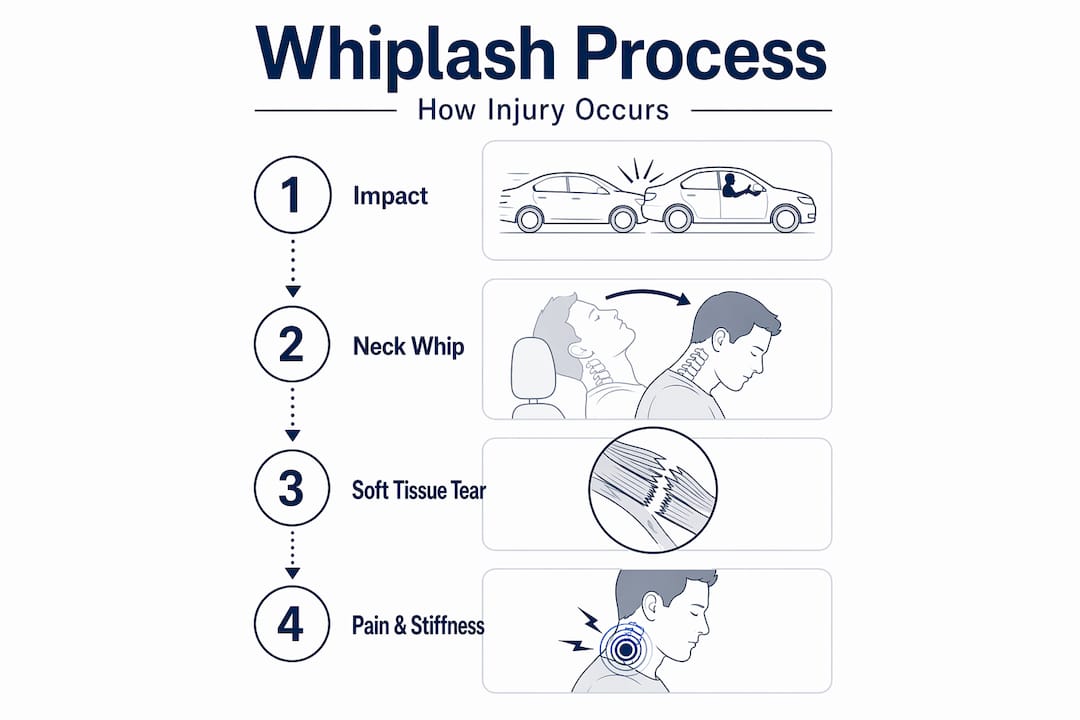
Whiplash deserves its own category. It is one of the most misunderstood injuries in car accident cases. Whiplash involves rapid head movement that strains the soft tissues of the neck, causing pain, headaches, stiffness, and sometimes neurological symptoms like tingling in the arms. Read more about whiplash injury claims if this sounds familiar.
Severity levels and what they mean
| Grade | Description | Typical Recovery |
|---|---|---|
| Grade I (Mild) | Minor stretching, minimal fiber damage | Days to a few weeks |
| Grade II (Moderate) | Partial tearing, noticeable swelling and pain | Several weeks to 3 months |
| Grade III (Severe) | Complete tear, significant instability | Months; may require surgery |
Severity directly affects both your recovery timeline and the value of your injury claim. A Grade III tear is not the same as a mild strain, and your medical documentation should reflect that distinction clearly.
One detail most people miss: car accident injury symptoms do not always appear immediately. Pain, swelling, and stiffness can take 24 to 72 hours to fully develop. This delayed onset is normal, but it can work against you if you wait too long to see a doctor.
Diagnosis and why X-rays are not enough
Here is where a lot of accident victims get misled. A doctor looks at your X-ray, sees no broken bones, and you are told you are fine. But X-rays show bones, not soft tissue. A completely normal X-ray result is entirely consistent with a serious ligament tear or muscle injury.
The imaging tools that actually reveal soft tissue damage are:
- MRI (Magnetic Resonance Imaging): The gold standard for identifying ligament tears, disc injuries, and muscle damage. If your symptoms persist, push for an MRI referral.
- Ultrasound: Useful for assessing tendons and muscles in real time. Faster and cheaper than MRI, though less detailed for deep structures.
- CT scans: Occasionally used when both bone and soft tissue involvement is suspected.
The misconception that no fracture means no injury is widespread and costly for accident victims. Insurance adjusters know this and will use a clean X-ray as a reason to minimize your claim.
Getting evaluated within 24 to 48 hours of your accident is not just medically smart. Early evaluation protects your legal claim by establishing a clear timeline between the crash and your injuries. A gap in medical care gives insurers room to argue your injuries came from somewhere else.
Pro Tip: Start a written symptom journal the day of your accident. Record your pain levels, where it hurts, what movements are difficult, and how it affects your sleep and daily activities. This journal becomes medico-legal evidence that no imaging test can replicate.
How to treat soft tissue injuries after a crash
Soft tissue damage recovery follows a predictable pattern when managed correctly. The problem is that many people either do too little or too much in the early stages.
Here is what a structured recovery typically looks like:
-
Immediate phase (Days 1 to 3): Focus on relative rest, not complete immobilization. Use ice packs for 15 to 20 minutes at a time to reduce swelling. Compression and elevation help control inflammation. Soft tissue injury treatment at this stage centers on controlling the initial inflammatory response without shutting it down entirely. Anti-inflammatories can actually slow healing if used too aggressively in this window.
-
Early rehab phase (Days 4 to 14): Avoid prolonged complete rest. Gentle, progressive movement reduces stiffness and prevents the tissue from healing in a shortened, weakened state. A physical therapist can guide you through safe range-of-motion exercises.
-
Active rehabilitation (Weeks 2 to 12+): This is where physical therapy becomes central. Strengthening exercises, manual therapy, and targeted stretching help restore full function. For whiplash specifically, restoring neck movement through guided therapy is a key treatment goal.
-
Return to full function: Depending on severity, this phase can take weeks or months. Grade III injuries may require specialist care or surgical evaluation.
Pro Tip: Do not stop physical therapy the moment you feel better. Soft tissue that has not fully remodeled is vulnerable to re-injury. Completing your full rehabilitation course also strengthens your claim by showing consistent, documented treatment.
One thing worth knowing: staged rehab with guided movement consistently produces better outcomes than passive rest. Treating early inflammation as a reason to do nothing risks increased stiffness and a longer overall recovery.
Watch for red flags that require urgent medical attention. Severe pain, numbness, inability to bear weight, or rapidly worsening swelling after your injury are signs you need emergency evaluation, not a wait-and-see approach.
How insurance companies handle soft tissue injury claims
This is the part most accident victims are not prepared for. Insurance companies are experienced at contesting soft tissue injury claims, and they have a playbook.
Their most common argument: "There is no objective evidence of injury." Because soft tissue damage does not show on an X-ray, adjusters will sometimes act as though the injury does not exist. This is why your documentation strategy matters so much.
Here is what you need to build a credible claim:
- Consistent medical treatment: Gaps in your care give insurers reason to argue you were not seriously hurt. Attend every appointment and follow your doctor's recommendations.
- Specialist reports: A report from a physical therapist, orthopedic specialist, or neurologist carries more weight than a general practitioner's notes alone.
- Daily symptom log: A coherent symptom timeline that records onset, progression, and functional impact translates your subjective pain into credible evidence.
- Proof of economic damages: Keep every receipt for medical bills, prescriptions, transportation to appointments, and any lost wages from missed work.
"Insurance claims require proof of duty, breach, causation, and damages. Well-documented, consistent medical care is the foundation of any successful soft tissue injury claim."
Understanding the difference between economic and non-economic damages also helps. Economic damages cover your medical bills and lost income. Non-economic damages cover pain and suffering, loss of enjoyment of life, and emotional distress. Both are legitimate parts of your claim, but non-economic damages are harder to prove without thorough documentation.
If your symptoms are serious, your recovery is taking longer than expected, or the insurance company is offering you a quick settlement, know your filing deadline before you sign anything. Accepting a settlement closes your claim permanently, even if your condition worsens later.
My take on what actually moves the needle
I have spent years working alongside car accident victims and the attorneys who represent them. Here is what I have seen actually make a difference, versus what sounds good in theory.
The biggest mistake I see is waiting. People feel shaken after a crash, assume the soreness will pass, and put off seeing a doctor for a week or two. By then, the gap in their medical timeline has already handed the insurance company an argument. Early evaluation is not about being dramatic. It is about protecting yourself.
The second thing I have seen consistently underestimated is the symptom journal. Most people do not bother. The ones who do, and who keep it detailed and daily, show up to settlement discussions with something no imaging test provides: a real, human account of how the injury affected their life. That carries weight.
What sounds good in theory but rarely helps: trying to negotiate directly with the insurance adjuster without legal guidance. Adjusters are trained negotiators working for the insurer, not for you. The accident victims I have seen get fair outcomes are the ones who got a personal injury attorney involved early, before they said too much or accepted too little.
— Scott
Get the legal help you deserve after your accident

If you are dealing with a soft tissue injury after a car accident, you do not have to figure out the claims process alone. WreckMatch was built specifically to help accident victims like you get connected with experienced personal injury attorneys quickly and without confusion. There is no upfront cost and no obligation. Most attorneys in our network work on a contingency fee basis, meaning you pay nothing unless you win your case.
You can get free legal help through WreckMatch in under 60 seconds. If you want to learn more before speaking with an attorney, WreckMatch also offers free weekly webinars where legal experts walk through injury claims, your rights, and what to expect from the process. Find car accident help in your state and take the next step today. Your injury is real. Your claim matters. Let WreckMatch help you protect it.
FAQ
What is a soft tissue injury in a car accident?
A soft tissue injury affects the muscles, ligaments, or tendons rather than bones. In car accidents, these injuries commonly include whiplash, sprains, strains, and contusions caused by the force of impact.
Why didn't my soft tissue injury show on an X-ray?
X-rays are designed to show bones, not soft tissue. MRI and ultrasound are the appropriate imaging tools for diagnosing ligament tears, muscle damage, and other soft tissue conditions.
How long does soft tissue damage recovery take?
Recovery depends on severity. Mild Grade I injuries may resolve in a few weeks, while moderate to severe injuries can take three months or longer, especially without proper rehabilitation.
Can I still file a claim if my symptoms appeared days after the crash?
Yes. Delayed onset of symptoms is well recognized in soft tissue injuries. Seeking medical care promptly and documenting your symptoms from the start strengthens your claim even when pain develops after the accident.
Do I need a lawyer for a soft tissue injury claim?
You are not required to hire a lawyer, but having one significantly improves your chances of a fair settlement. Personal injury attorneys who work on contingency cost nothing upfront and can handle negotiations with the insurance company on your behalf.