
Truck accident liability is the legal assignment of responsibility for injuries and property damage caused by a commercial truck crash. Unlike a standard car accident, a single truck crash can involve six or more potentially liable parties: the driver, the motor carrier, a freight broker, a shipper, a maintenance company, and a parts manufacturer. Federal law and state comparative fault rules both shape how that responsibility gets divided. If you were hurt in a truck crash, understanding who owes you compensation and how that determination is made is the first step toward protecting your rights.
Truck accident liability explained: who can be held responsible?
Truck accident liability law recognizes that crashes rarely have just one cause. Multiple parties share responsibility depending on their role in the chain of events that led to the collision.
Here is a breakdown of each potential defendant:
- Truck drivers are liable when their own negligent actions cause a crash. Driver negligence includes fatigue, intoxication, distracted driving, and speeding. Hours-of-service violations are among the most common triggers for driver liability claims.
- Motor carriers face two types of liability. Vicarious liability applies when a driver is their employee and causes a crash on the job. Direct liability applies when the carrier itself was negligent in hiring, training, supervising, or maintaining equipment.
- Freight brokers can be held liable for negligent carrier selection, such as hiring a carrier with expired insurance or a history of safety violations.
- Shippers and loaders carry a legal duty for proper cargo securing. Improperly loaded freight that shifts during transit and causes a rollover or jackknife can make the shipper a defendant.
- Maintenance companies and third-party repair shops can be liable when faulty repairs or missed inspections contribute to a mechanical failure.
- Parts manufacturers face strict product liability when defective components such as brakes, tires, or steering systems fail and cause a crash. Strict liability means you do not need to prove the manufacturer was careless. You only need to prove the part was defective.
Pro Tip: Preserve every piece of evidence immediately after a crash. Trucking companies are required to retain logs, inspection records, and maintenance files, but they can legally destroy some records within months. Request preservation in writing as soon as possible. Wreckmatch's evidence preservation guide walks you through exactly what to request.
The complexity of identifying all liable parties is exactly why truck accident cases differ so sharply from standard car accident claims. A semi truck claim involves federal regulations, multiple insurance policies, and corporate defendants that standard auto claims do not.

How is liability determined and shared in truck accidents?
Fault in a truck accident is not always assigned 100% to one party. Most states use comparative fault rules that split responsibility among multiple parties, including sometimes the victim.
State fault rules: a quick comparison
| State rule | How it works | Effect on your recovery |
|---|---|---|
| Pure comparative fault (e.g., Kentucky) | You recover even if you are 99% at fault | Your award is reduced by your fault percentage |
| Modified comparative fault, 51% bar (e.g., Texas) | You recover only if you are 50% or less at fault | You lose all recovery if you are 51% or more at fault |
| Modified comparative fault, 50% bar | You recover only if you are less than 50% at fault | Being exactly 50% at fault bars recovery |
| Contributory negligence (e.g., Virginia) | Any fault on your part bars recovery entirely | Even 1% fault eliminates your claim |
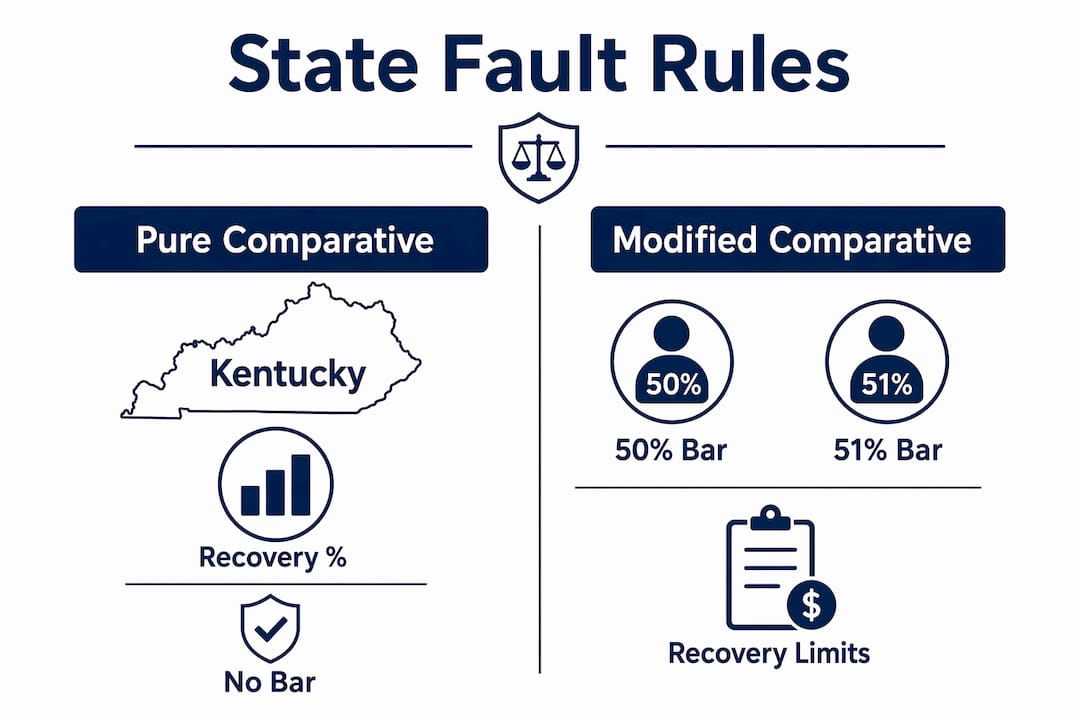
State comparative fault laws directly determine how much money you can recover. Knowing your state's rule before accepting any settlement offer is critical.
Federal insurance requirements add another layer. Interstate motor carriers must carry a minimum of $750,000 in liability insurance, and most large carriers hold policies ranging from $1 million to $5 million. That coverage range matters because truck accident injuries are often severe and medical costs can exceed a standard auto policy within days.
Insurance adjusters complicate this process. Adjusters often assign partial fault to victims as a negotiation tactic to reduce settlement amounts. That initial fault assignment is not final. It is a starting position, and it can be challenged with the right evidence and legal representation.
Pro Tip: Never accept an adjuster's fault determination as fact. Review Wreckmatch's insurance adjuster guide to understand what adjusters are doing and how to respond.
When multiple defendants share liability, each party's insurance carrier may dispute how much of the total fault belongs to their client. This creates parallel negotiations that can drag on for months without an attorney coordinating the strategy.
What impact does driver classification have on liability?
Whether a truck driver is classified as an employee or an independent contractor is one of the most consequential legal questions in a truck accident case. The answer determines whether the motor carrier is legally responsible for the driver's actions.
Under the respondeat superior doctrine, employers are automatically liable for negligent acts their employees commit during the course of their work. Driver classification directly shapes how that doctrine applies.
Key factors courts examine when determining classification include:
- Control over schedules and routes: Does the carrier dictate when and where the driver travels?
- Equipment ownership: Does the driver own the truck, or does the carrier provide it?
- Exclusivity: Does the driver work only for one carrier, or multiple companies?
- Economic dependence: Is the driver financially dependent on a single carrier for income?
- Integration into operations: Is the driver's work central to the carrier's core business?
Many carriers label drivers as independent contractors specifically to avoid respondeat superior liability. Courts push back on this. The 2024 Department of Labor six-factor economic reality test evaluates the true nature of the working relationship, not just what the contract says. Classification disputes center on actual control, and courts have repeatedly found that a contractor label does not automatically shield a carrier from liability.
For victims, this matters because an independent contractor classification can limit which insurance policy applies and reduce the total compensation available. An attorney experienced in trucking cases will investigate the actual working relationship, not just the contract language.
How recent legal developments affect truck accident liability claims
Truck accident liability laws shifted in meaningful ways heading into 2026. If your case is in Texas or involves a carrier operating under recent federal guidance, these changes affect your strategy directly.
-
Texas House Bill 19 bifurcated trials. Texas HB 19 requires two-phase trials that separate driver liability from company negligence claims. In phase one, the jury decides whether the driver was at fault. Only if the driver is found liable does phase two proceed, where the jury considers corporate negligence claims like negligent entrustment or negligent hiring. This structure makes it harder to hold carriers accountable and requires a more deliberate litigation strategy from the start.
-
Negligent entrustment as a corporate liability tool. The negligent entrustment doctrine allows courts to hold motor carriers directly liable for knowingly allowing an unfit driver to operate a truck. This shifts accountability from the driver to the boardroom. Proving it requires corporate records, hiring files, and safety audit histories.
-
Digital evidence from FMCSA Clearinghouse and telematics. Proving corporate negligence now often depends on data from the Federal Motor Carrier Safety Administration's Drug and Alcohol Clearinghouse, electronic logging devices, and GPS telematics systems. This data can show a carrier knew a driver had prior violations and hired or retained them anyway. Wreckmatch's guide to black box and FMCSA evidence explains how this data is obtained and used.
-
Joint and several liability limitations. Texas law limits joint and several liability, meaning you may not be able to collect the full judgment from one defendant if multiple parties share fault. Each defendant may only pay their proportional share, which makes identifying and naming all liable parties from the beginning even more important.
-
Statute of limitations pressure. Most states give truck accident victims two years to file a lawsuit, but evidence like telematics data and driver logs can disappear much faster. Acting quickly is not just good advice. It is a legal necessity.
Pro Tip: If your crash happened in Texas, ask your attorney specifically how HB 19 affects your case before any litigation strategy is set. The bifurcation requirement changes how evidence is sequenced and presented at trial.
Key takeaways
Truck accident liability involves multiple parties, state-specific fault rules, and federal insurance requirements that together determine how much compensation you can recover.
| Point | Details |
|---|---|
| Multiple liable parties | Drivers, carriers, brokers, shippers, and manufacturers can all share fault in a single crash. |
| Federal insurance minimums | Interstate carriers must carry at least $750,000 in liability coverage; most hold $1M–$5M policies. |
| State fault rules matter | Your state's comparative fault law directly controls how much of your damages you can recover. |
| Driver classification is critical | Employee versus contractor status determines whether the carrier is automatically liable for driver negligence. |
| Recent legal changes | Texas HB 19 and the negligent entrustment doctrine are reshaping how corporate liability is proven in 2026. |
What I've learned about truck accident liability that most victims miss
I have worked with enough truck accident victims to know that the biggest mistake people make is focusing only on the driver. The driver is the most visible defendant, but they are rarely the only one, and often not the deepest pocket in the case.
Carriers spend significant resources on legal teams whose job is to contain liability. They label drivers as contractors. They argue that a crash was the driver's personal fault, not a company failure. They send adjusters quickly, sometimes within hours of a crash, to gather statements before victims understand what happened or what their rights are.
The liability disputed in personal injury claims is almost always a deliberate strategy, not an honest disagreement. Adjusters know that early settlements, even low ones, close cases before victims understand the full scope of their injuries or the full list of defendants.
What actually moves these cases is evidence of corporate negligence. A carrier that hired a driver with a history of hours-of-service violations, or that skipped required maintenance inspections, is far more exposed than one that can show clean records. Digital evidence from telematics systems and the FMCSA Clearinghouse has changed what is provable. Cases that would have settled low five years ago are now worth pursuing aggressively because the data exists to prove what the carrier knew and when they knew it.
My advice: do not wait. Do not give recorded statements to adjusters. And do not assume the driver's insurance policy is the only money available to you. The settlement factors in a truck case are far more complex than in a standard car accident, and the difference between a fair outcome and a bad one usually comes down to how quickly you get the right legal help.
— Scott
Get free legal help after a truck accident
If you were hurt in a truck crash, you do not have to figure this out alone. Wreckmatch connects accident victims with experienced personal injury attorneys in 60 seconds, at no upfront cost. Attorneys in the Wreckmatch network work on contingency, meaning you pay nothing unless you win.
Start with the Accident Survival Guide to understand your rights, then let Wreckmatch match you with a qualified attorney who handles truck accident cases in your state. You can also browse legal help by state to find resources specific to where your crash happened. The sooner you act, the better your chances of preserving the evidence that wins cases.
FAQ
Who is liable in a truck accident?
Liability in a truck accident can fall on the driver, the motor carrier, a freight broker, a shipper, a maintenance company, or a parts manufacturer. Multiple parties often share fault in a single crash.
What is the minimum insurance a truck driver must carry?
Federal law requires interstate motor carriers to carry at least $750,000 in liability insurance. Most large carriers hold policies between $1 million and $5 million.
How does comparative fault affect my truck accident claim?
Your state's comparative fault rule determines how much you can recover if you share any blame for the crash. In pure comparative fault states like Kentucky, you can still recover even with significant fault. In Texas, you are barred from recovery if you are 51% or more at fault.
Does it matter if the truck driver was an independent contractor?
Yes. If the driver is classified as an independent contractor rather than an employee, the motor carrier may argue it is not responsible for the driver's actions. Courts look at the actual working relationship, not just the contract label, to make this determination.
What is negligent entrustment in a truck accident case?
Negligent entrustment is a legal doctrine that holds a motor carrier directly liable for allowing an unfit or unqualified driver to operate one of its trucks. Proving it typically requires access to the carrier's hiring records, safety audits, and FMCSA Clearinghouse data.
Recommended
- Semi Truck Accident Victim Guide — Nationwide (2026) | WreckMatch Blog | WreckMatch
- 18-Wheeler Crash in Lubbock, Texas — Victim Guide (2026) | WreckMatch Blog | WreckMatch
- 18-Wheeler Crash in Los Angeles, California — Victim Guide (2026) | WreckMatch Blog | WreckMatch
- Semi Truck Accident in Los Angeles, California: What to Do (2026) | WreckMatch Blog | WreckMatch