
If you've been in an accident and heard the term "bodily injury coverage," you may have assumed it protects your own injuries. It doesn't. Understanding what does bodily injury coverage mean is one of the most misunderstood parts of auto insurance, and that confusion can cost you. This coverage is about protecting others from financial harm when you cause an accident. Knowing exactly how it works, what it pays for, and where it falls short puts you in a far stronger position whether you're filing a claim, facing a lawsuit, or just trying to figure out your next step.
Table of Contents
- Key takeaways
- What bodily injury coverage means and what it covers
- State requirements and coverage limits
- What bodily injury coverage does not cover
- Why bodily injury coverage matters: legal and financial stakes
- My honest take on what most drivers get wrong
- Injured after an accident? WreckMatch can help
- FAQ
Key takeaways
| Point | Details |
|---|---|
| Covers others, not you | Bodily injury liability pays for injuries you cause to other people, not your own medical bills. |
| Required in nearly every state | Mandatory in 49 states, minimum limits vary widely from $15,000 to $50,000 per person. |
| Your assets are on the line | If a claim exceeds your policy limits, you can be held personally liable for the difference. |
| Know what's excluded | Your own passengers are typically not covered under bodily injury liability. |
| Rising costs mean more risk | Claim costs rise 3 to 4 times faster than general inflation due to social inflation. |
What bodily injury coverage means and what it covers
Bodily injury liability coverage is a type of auto insurance that pays for injuries you cause to other people in an accident where you are at fault. It does not cover your own injuries. Think of it as financial protection for the person on the other side of the crash.
Bodily injury liability coverage is mandatory in 49 out of 50 U.S. states. When you're found at fault in a collision, your policy steps in to cover the costs you would otherwise owe out of pocket.
Here is what bodily injury liability typically covers:
- Medical bills for the other driver and their passengers
- Lost wages if the injured person misses work during recovery
- Pain and suffering damages claimed by the injured party
- Legal defense costs if the other party decides to sue you
- Funeral expenses in the event of a fatal accident
That last one matters more than people realize. A serious crash doesn't just mean hospital bills. It can mean months of litigation, lost income claims, and pain and suffering awards that run well into six figures.
Pro Tip: Bodily injury coverage also includes your legal defense costs if you are sued. That alone can easily reach $50,000 or more in a contested personal injury case, even if you ultimately win.
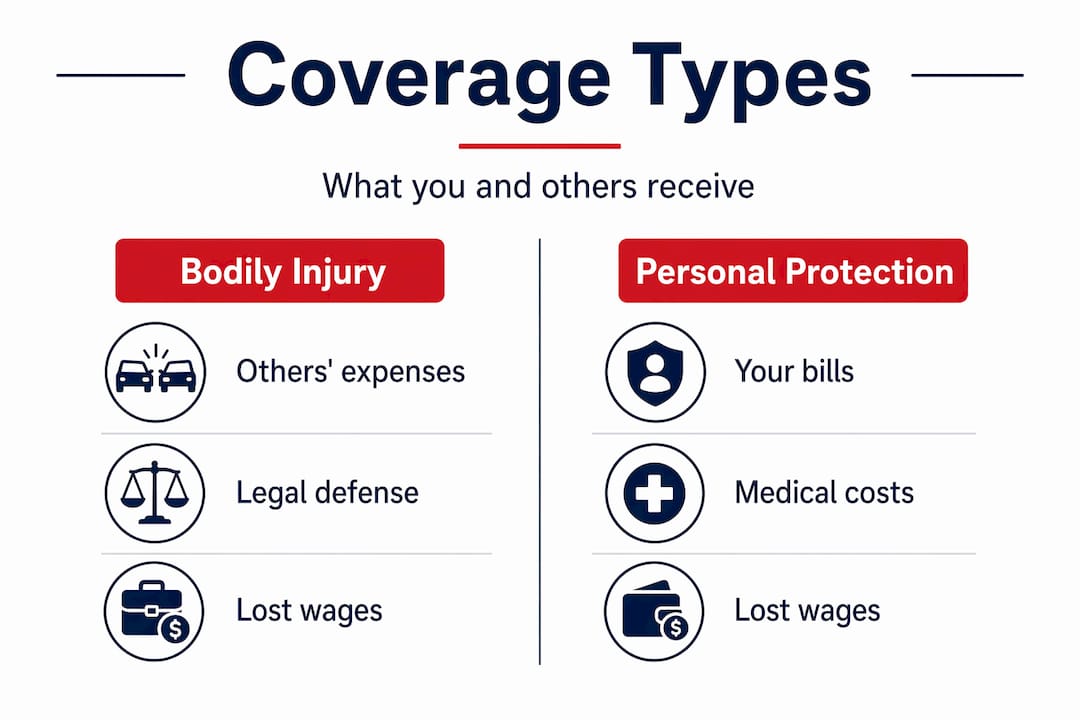
It's also worth understanding the difference between bodily injury and property damage liability. Bodily injury covers physical harm to people. Property damage covers vehicle and property repair. They are separate coverages, often listed together on your policy as a combined liability package, but they serve different purposes. Neither one pays for your own injuries or your own car.
You can check the accident legal glossary on WreckMatch if you want clear definitions for terms like "liability," "coverage limits," and "per-occurrence."
State requirements and coverage limits
Almost every state requires drivers to carry a minimum amount of bodily injury liability coverage. The numbers are typically written in a format like 25/50, meaning $25,000 per person injured and $50,000 per accident total.
Here's a quick look at how state minimums and recommended limits compare:
| Coverage Level | Per Person | Per Accident | Who It's For |
|---|---|---|---|
| State minimum (low) | $15,000 | $30,000 | Bare legal compliance only |
| Mid-range | $50,000 | $100,000 | Average-risk drivers |
| Recommended | $100,000 | $300,000 | Drivers with assets to protect |
| High-net-worth | $250,000+ | $500,000+ | High asset, high exposure drivers |
Experts recommend 100/300 coverage limits as a baseline for drivers who own property, have savings, or carry any real financial exposure. Here's why: if you cause a serious accident and the other driver's injuries exceed your policy limits, you pay the rest. Your savings account, your car, even a portion of your wages can become fair game in a civil lawsuit.
State-minimum limits feel affordable until you're in a situation where they're not enough. A single surgery can cost more than $50,000. A hospitalization with follow-up care can run six figures. If your limit is $15,000 per person and the bill is $80,000, you are personally responsible for that $65,000 gap.

Pro Tip: Match your bodily injury coverage limits to your net worth. If you have $150,000 in assets, carry at least $100,000 per person in coverage. Your policy exists to protect what you've built.
You can find state-specific coverage requirements by state through WreckMatch to understand exactly what your state mandates and how it compares to what financial advisors recommend.
What bodily injury coverage does not cover
This is where most people get tripped up. Bodily injury liability coverage has real gaps, and not knowing them can leave you in a bad spot after a crash.
Here is what bodily injury liability does not cover:
- Your own medical bills. If you cause an accident and get hurt, bodily injury coverage pays nothing toward your treatment.
- Your own vehicle damage. That requires collision coverage, which is separate.
- Your passengers' injuries. Bodily injury coverage generally does not cover your own passengers. They typically need to rely on their own health insurance or their own Personal Injury Protection (PIP) policy.
- Intentional acts. If you cause harm on purpose, coverage is void.
- Business or professional activities. Certain professional activities may be excluded from bodily injury liability, meaning claims can be denied even when injuries clearly occurred.
So what covers your own injuries? That depends on your state and your policy.
Personal Injury Protection, known as PIP, pays for your medical expenses and lost wages regardless of who caused the accident. It's required in no-fault states and optional in others. Medical Payments coverage, or MedPay, works similarly but typically has lower limits and fewer benefits.
The distinction matters. Bodily injury liability protects you from financial loss when you injure others. PIP and MedPay protect you when you're injured. These are not the same thing, and having one does not mean you have the other.
Understanding your full coverage picture, including what's missing, is the first step toward protecting yourself after a crash. If you're unsure, WreckMatch's car accident claim timeline walks through the claims process step by step.
Why bodily injury coverage matters: legal and financial stakes
The financial consequences of a serious bodily injury claim have never been higher. And they're climbing.
Bodily injury claims represent over 50% of all liability claim payouts, and costs are rising faster than general inflation due to a trend called social inflation. This includes more aggressive plaintiff attorneys, larger jury awards, and longer litigation timelines. The result: even a moderate accident can generate a claim that exceeds what most drivers ever expected.
"Bodily injury claim costs are rising at 3 to 4 times the overall inflation rate, driven by aggressive litigation strategies and expanding jury verdicts. Drivers carrying state minimums are increasingly underinsured." — Insurify Research
This isn't just an insurance industry problem. It's your problem if you're underinsured. Severe bodily injury claims involve high volatility and tail risk, meaning costs can spiral far beyond what initial estimates suggest. A claim that looks like a $30,000 injury case can balloon into a $200,000 settlement when pain and suffering, long-term care, and legal fees are factored in.
If you're the person injured in an accident caused by someone else, their bodily injury liability coverage is what you'll be making a claim against. That's the fund that pays for your medical treatment, your time off work, and potentially your pain and suffering. Knowing how that coverage works, and its limits, helps you understand what you're entitled to and when you might need an attorney to push for a fair outcome.
If the at-fault driver is carrying only state minimums and your injuries are serious, their coverage may not be enough. That's when your own uninsured or underinsured motorist coverage becomes critical, and when legal help can make a real difference in your recovery.
My honest take on what most drivers get wrong
I've worked with hundreds of accident victims, and the same pattern comes up constantly. People assume they're covered because they have insurance. They don't realize their bodily injury limits are too low until a lawsuit arrives. Then it's too late to change the policy.
The state minimum limits feel like a safe floor. They're not. They're a legal floor, which is a very different thing. A $15,000 per-person policy in 2026 might not cover two hours in an emergency room for a serious trauma case. I've seen drivers lose significant personal assets because their $25,000 limit got swallowed by one accident involving two injured people.
What I tell people is this: your bodily injury coverage limits should reflect your real exposure, not your desire to save $40 a month on premiums. If you own a home, have retirement savings, or run a small business, you are a target in civil litigation. A plaintiff's attorney will look at your assets. Your insurance company will only pay up to your limit. You pay the rest.
There's also a less-discussed issue around passenger coverage. Most people assume their passengers are covered under their bodily injury policy. They're usually not. Understanding state-specific passenger coverage is something most drivers have never done, and it's a real gap. If a friend gets hurt in your car during an accident you caused, the claims process gets complicated fast.
Review your policy. Call your insurer. Ask specifically: what are my bodily injury limits, and are my passengers covered under any of my policies? Those two questions alone could save you from a financial disaster.
— Scott
Injured after an accident? WreckMatch can help
If you've been hurt in a crash, understanding the other driver's bodily injury coverage is just the beginning. Knowing your rights, the timeline of a claim, and when to get legal help are the steps that actually protect you.
WreckMatch connects accident victims with experienced personal injury attorneys quickly and at no upfront cost. Attorneys work on contingency, meaning you pay nothing unless you win. Whether you're dealing with a lowball settlement offer, a dispute over fault, or injuries that insurance won't fully cover, getting the right legal help early makes a difference. Start with the Accident Survival Guide to understand your options, or use WreckMatch's free attorney matching to get connected with a licensed attorney in your state today.
FAQ
What does bodily injury coverage mean in simple terms?
Bodily injury coverage is the part of your auto insurance that pays for injuries you cause to other people when you are at fault in an accident. It covers their medical bills, lost wages, and legal costs if they sue you.
Does bodily injury coverage pay for my own injuries?
No. Bodily injury liability only covers injuries to others. For your own injuries, you need Personal Injury Protection (PIP), MedPay, or your own health insurance.
Are my passengers covered under bodily injury liability?
Generally, no. Passengers typically rely on their own health insurance or a PIP policy, not the driver's bodily injury liability coverage.
How much bodily injury coverage do I need?
Most financial advisors recommend at least 100/300 limits, meaning $100,000 per person and $300,000 per accident. Carrying limits below your net worth exposes your personal assets to civil judgments.
What happens if the at-fault driver's bodily injury limits aren't enough?
If the other driver's policy doesn't fully cover your losses, you may need to file a claim under your own underinsured motorist coverage or pursue additional legal action. An attorney can help you identify every available source of compensation.