
If you or someone in your family was hurt in an accident, you have probably heard the phrase "compensacion por accidente" and wondered exactly what it covers. Understanding what does compensacion por accidente mean is more than a translation exercise. It is about knowing what money you are legally owed, what you can claim, and what mistakes could cost you everything. This article breaks down the accident compensation meaning in plain terms, walks you through how it is calculated, and shows you the exact steps to protect your rights starting today.
Table of Contents
- Key takeaways
- What does accident compensation mean legally and financially?
- How accident compensation is calculated
- Types of accident compensation and how they work
- Practical steps to claim and maximize your compensation
- Real examples of accident compensation outcomes
- My honest take on understanding accident compensation
- Get free help from Wreckmatch right now
- FAQ
Key takeaways
| Point | Details |
|---|---|
| Compensation covers two damage types | You can recover both economic losses like medical bills and non-economic losses like pain and suffering. |
| Fault percentage reduces your payout | If you are found partly at fault, your total compensation is reduced by that percentage. |
| Never accept the first offer | Initial insurance offers are almost always low and accepting them can waive your right to future benefits. |
| Documentation is your strongest asset | Medical records, police reports, and a daily pain journal directly determine how much you recover. |
| Legal help costs nothing upfront | Most personal injury attorneys work on contingency, meaning you pay nothing unless you win. |
What does accident compensation mean legally and financially?
Compensacion por accidente, translated directly, means "accident compensation." In legal terms, it refers to money paid to a person who was injured due to someone else's negligence or wrongdoing. The goal is to restore you as close as possible to where you were before the accident. It is not about punishing the at-fault party or making you rich. As one legal resource explains, compensation aims to restore your status quo, not enrich you.
There are two main categories every accident victim needs to understand.
Economic damages are losses you can measure in dollars and cents:
- Medical bills (emergency room, surgery, physical therapy, prescriptions)
- Lost wages from time missed at work
- Future medical costs if your injury requires ongoing treatment
- Property damage, such as your car
Non-economic damages are real but harder to put a number on:
- Physical pain and suffering
- Emotional distress and anxiety
- Loss of enjoyment of daily activities
- Damage to your personal relationships
Together, economic and non-economic damages make up the full picture of what you lost. Both are valid. Both can be recovered.
Compensation is not a gift from the insurance company. It is money you are legally owed because someone else's negligence caused your injury.
The term "indemnity" in accident law, sometimes called "what is accident indemnity," means the same thing. It refers to protection or payment that makes you whole again. You will see this term used in insurance policies and legal documents. When you see it, know that it refers to the same concept of restoring your financial position after a loss.
Evidence and documentation drive the entire process. Without proof, even a valid claim can be reduced or denied. Keep every receipt, every doctor's note, and every piece of paper related to your accident.
How accident compensation is calculated
The accident compensation meaning changes when you start talking about numbers. Most people are surprised that there is no single fixed dollar amount for any injury. The amount you receive depends on specific facts about your case.
Here is a common formula used in personal injury claims:
Total Compensation = (Economic Damages + Non-Economic Damages) x (1 minus Fault Percentage)
Non-economic damages are typically calculated using a multiplier applied to your economic damages. The multiplier range depends on the severity of your injuries.
| Injury Severity | Typical Multiplier Range | Example (on $20,000 economic damages) |
|---|---|---|
| Minor (soft tissue, bruising) | 1.0x to 1.5x | $20,000 to $30,000 |
| Moderate (fractures, concussion) | 1.5x to 3.0x | $30,000 to $60,000 |
| Severe (surgery, permanent injury) | 3.0x to 4.5x | $60,000 to $90,000 |
| Head-on collision (typical) | ~1.4x | $28,000 |
Calculations often use multipliers ranging from 1.5x to 4.5x depending on severity and accident type. Your attorney or the insurance adjuster will apply this formula to your documented losses.
Fault percentage is where many claims shrink. If a jury or adjuster decides you were 20% responsible for the accident, your compensation is reduced by 20%. This is called comparative negligence. Some states use a "51% rule," meaning if you are more than 50% at fault, you collect nothing. Check state-specific compensation laws because the rules vary significantly.
Pro Tip: Never accept a fault percentage assigned by an insurance adjuster without first consulting an attorney. Adjusters have an incentive to assign you more fault than the facts support, and that directly reduces your payout.
Medical documentation is the backbone of your calculation. Gaps in treatment give adjusters an opening to argue your injuries are not serious, reducing your settlement significantly. See every doctor, follow every treatment plan, and keep every record.

Types of accident compensation and how they work
Understanding accident compensation also means knowing where the money comes from. There are two major systems, and confusing them is one of the most common mistakes injured people make.
Workers' compensation applies when you are hurt on the job. It covers medical costs, a portion of your lost wages, and disability benefits. Workers' compensation is a no-fault system, meaning you do not have to prove your employer was negligent. You simply need to show the injury happened while you were working.
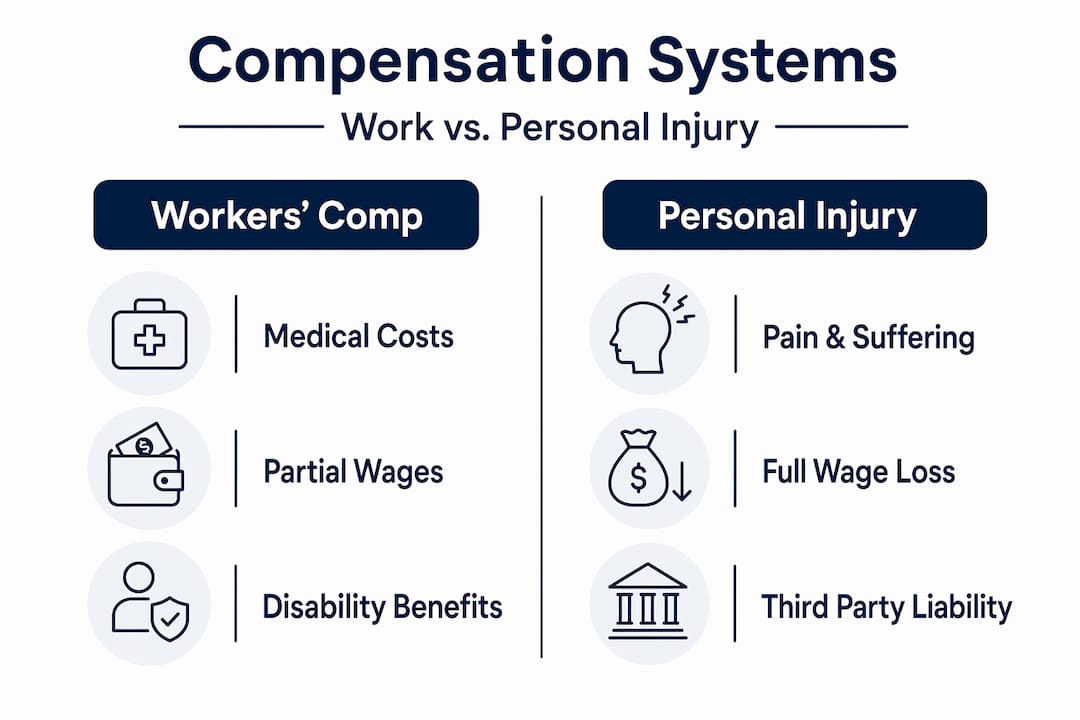
Personal injury claims apply when a third party caused your accident, such as another driver or a property owner. These claims require proving fault and can result in larger payouts because they include full non-economic damages.
Here is what matters about each type:
- Workers' comp requires timely reporting and documentation. Delay often means denial.
- Personal injury claims have statutes of limitations, typically one to three years depending on your state.
- Both systems can apply at the same time in some cases, such as when a delivery driver is injured by another car while on the job.
- A 2026 Supreme Court ruling confirmed that statutory and private benefits cannot be deducted from each other, meaning you may be entitled to collect from both sources.
One major misconception involves vehicle accidents and workers' comp. Many people assume that if they were driving for work and got in a crash, workers' comp automatically covers them. That is not always true. Workers' comp coverage for vehicle accidents depends entirely on whether you were acting within the scope of your employment at the time. Driving to and from work is typically excluded.
Private insurance, such as uninsured motorist coverage or medical payments coverage, adds another layer. These are contractual benefits you paid for through your premiums, and they exist separately from any legal claim you file.
Practical steps to claim and maximize your compensation
Knowing the accident compensation meaning is one thing. Acting correctly after an accident is another. The first 72 hours matter more than most people realize.
- Report the accident immediately. Call the police, file a report, and notify your employer if it was a work injury. Late reporting is one of the top reasons claims are denied.
- Get medical attention right away. Even if you feel okay, see a doctor. Some injuries, like whiplash or internal bleeding, take days to show symptoms. A gap between the accident and your first medical visit gives adjusters ammunition to dispute your injuries.
- Document everything. Take photos of the scene, your injuries, and any property damage. Collect witness contact information. Save every medical bill, prescription receipt, and correspondence.
- Start a daily pain journal. Write down your physical pain level, any emotional struggles, and how your injuries limit daily activities. A daily pain journal is a powerful but underused tool that directly supports your non-economic damage claim.
- Do not speak to the other party's insurance company without legal counsel. Their adjuster is not on your side. Insurance adjusters use tactics to minimize payouts by questioning injury severity and looking for inconsistencies in your story.
- Never accept the first offer. Initial insurance offers are typically low and accepting quickly can permanently waive your right to future benefits, including compensation for complications that arise months later.
- Consult a personal injury attorney. Most work on contingency, meaning no upfront cost to you. An attorney knows how to calculate your full case value and negotiate from a position of strength.
Pro Tip: If an adjuster calls you and says "we just need a quick recorded statement," politely decline until you have spoken with an attorney. That recorded statement can and will be used to reduce your claim.
Real examples of accident compensation outcomes
Abstract numbers become real when you see how compensation plays out in actual cases. Here are scenarios that reflect common claim outcomes.
| Accident Type | Injury | Economic Damages | Multiplier Applied | Estimated Total |
|---|---|---|---|---|
| Car accident (rear-end) | Soft tissue, back pain | $8,500 | 1.5x | ~$12,750 |
| Slip and fall (public property) | Fractured wrist | $22,000 | 2.5x | ~$55,000 |
| Workplace injury | Torn ligament, surgery | $45,000 | 3.5x | ~$157,500 |
| Head-on collision | Traumatic brain injury | $120,000 | 4.0x | ~$480,000 |
Permanent disability changes everything. A temporary injury that heals in three months will receive a much lower multiplier than one that affects your ability to work permanently. Courts and adjusters look at age, occupation, and long-term medical prognosis. A 35-year-old construction worker with a permanent back injury has a much stronger case for high non-economic damages than someone whose injury resolved fully in six weeks.
The difference between settlements also reflects how well the victim was documented. Victims with continuous medical records, a completed pain journal, and clear non-economic damage evidence consistently recover more than those without.
Legal precedent and expert testimony also play a role in larger claims. Doctors, vocational experts, and economists are sometimes called to testify about future earning loss or the extent of disability, adding credibility to the numbers claimed.
My honest take on understanding accident compensation
I have spent years watching injured people underestimate their own claims. Here is what I have learned. Most people walk into this process thinking the insurance company will be fair. They will not. Insurance companies are businesses, and paying out claims is a cost to be minimized. That is not a criticism. It is just reality.
The biggest mistake I see? Accepting the first offer out of financial desperation. I understand it. Bills pile up. You cannot work. The check feels like relief. But initial low-ball offers are almost always a test of how desperate you are, and cashing that check often closes the door on everything you are still owed.
What actually builds strong claims is boring, consistent work. Seeing your doctor every week. Writing in your pain journal every night. Keeping every receipt. That documentation is the only thing standing between you and a lowball settlement.
If I could tell every accident victim one thing, it would be this: you do not have to figure this out alone, and getting legal help costs you nothing upfront. Talk to an attorney before you sign anything.
— Scott
Get free help from Wreckmatch right now
You deserve to understand your rights and get real support after an accident. Wreckmatch connects injured people with experienced personal injury attorneys at no upfront cost. In 60 seconds or less, you can be matched with a licensed attorney who handles cases like yours.
Wreckmatch has Spanish-speaking support and resources built specifically for families navigating this process for the first time. Start with the accident survival guide to understand your rights step by step. Not sure what a legal term means? The legal glossary explains every key phrase in plain language. Ready to talk to an attorney? Visit WreckMatch now and get free legal help today. No fees unless you win. No pressure. Just real support when you need it most.
FAQ
What does "compensacion por accidente" mean in English?
"Compensacion por accidente" means accident compensation in English. It refers to the money an injured person is legally owed after being hurt due to someone else's negligence, covering both measurable financial losses and subjective losses like pain and suffering.
What is accident indemnity and how is it different from compensation?
Accident indemnity and accident compensation refer to the same concept. Indemnity is the legal term found in insurance policies, while compensation is used in personal injury claims. Both mean restoring a victim's financial position after an injury caused by another party.
How does accident compensation work if I was partly at fault?
If you were partly at fault, your total compensation is reduced by your fault percentage under comparative negligence rules. For example, if you were 25% at fault and your total damages were $100,000, you would receive $75,000.
Can I claim both workers' compensation and a personal injury settlement?
Yes, in some situations. If a third party caused your work injury, such as another driver hitting you while you were on the job, you may be able to file a workers' comp claim and a separate personal injury lawsuit at the same time.
Why should I avoid accepting the first insurance offer?
Initial insurance offers are almost always lower than your actual claim value. Accepting quickly can permanently waive your right to additional compensation, including for injuries or complications that appear later. Always consult an attorney before signing any settlement agreement.