
A personal injury claim is a formal legal demand for financial compensation when someone else's negligence or wrongdoing causes you harm. In legal practice, this is also called a tort claim. The process typically starts as an insurance claim and may escalate into a lawsuit if a fair settlement is not reached. Your claim can cover physical injuries, psychological harm, medical bills, and lost income. Whether you were hurt in a car accident, a slip and fall, or a workplace incident, understanding how this process works is the first step toward protecting your rights.
What is a personal injury claim under the law?
A personal injury claim is a legal tool that lets you seek compensation from the person or party responsible for your injury. The formal legal term is a "tort claim," and it falls under civil law, not criminal law. That distinction matters. A criminal case punishes the wrongdoer. A civil personal injury claim compensates you, the victim.
The claim covers two broad categories of harm. First, economic damages include measurable losses like hospital bills, physical therapy costs, and wages you could not earn while recovering. Second, non-economic damages cover pain and suffering, emotional distress, and loss of enjoyment of life. Both categories are legitimate and recoverable, though the amounts vary by case and state.

Most people do not realize that psychological injuries count too. If a car accident left you with anxiety, PTSD, or depression, those conditions can be included in your claim. The law recognizes that harm is not always visible.
What are the four legal elements you must prove?
Four legal elements must be proven for any negligence-based personal injury claim to succeed. Missing even one of them can end your case. Here is what each element means in plain terms:
- Duty of care. The other party had a legal responsibility to act safely toward you. A driver owes a duty of care to everyone on the road. A store owner owes it to customers walking through the door.
- Breach of duty. The other party failed to meet that responsibility. Running a red light, leaving a wet floor unmarked, or ignoring a product defect all qualify as a breach.
- Causation. Their breach directly caused your injury. This is the link between what they did wrong and the harm you suffered. Courts require clear evidence connecting the two.
- Damages. You suffered real, measurable harm. Without documented losses, there is nothing to compensate.
The biggest early factor for success is not the severity of your injury. Proving duty, breach, and causation with solid evidence is what actually moves a claim forward. A broken arm with no clear liability is harder to win than a minor injury with strong proof of fault.
Intentional wrongdoing cases, like assault, follow a slightly different legal path. You do not need to prove negligence. You only need to show the act was deliberate and caused harm.
Pro Tip: Document everything from day one. Photos, medical records, witness names, and written accounts of how the injury affects your daily life all build the evidence foundation your attorney needs.
What types of incidents qualify as personal injury claims?
Personal injury claims cover a wide range of incident types, each with its own rules and evidence requirements. Knowing which category your situation falls into helps you understand what proof you will need.
Common types include:
- Car accidents (the most frequent category in the U.S.)
- Slip and fall accidents on someone else's property
- Workplace injuries that fall outside workers' compensation coverage
- Medical malpractice when a healthcare provider causes harm through error or negligence
- Product liability when a defective product injures a consumer
- Dog bites where the owner is held responsible
- Wrongful death claims filed by surviving family members
For a deeper look at each category, Wreckmatch has a full breakdown in its types of personal injury claims guide.
The evidence requirements differ significantly by type. A car accident claim relies on police reports, photos, and witness statements. A medical malpractice claim typically requires expert medical affidavits and detailed records. Product liability cases may need engineering analyses or defect documentation. That variation in required proof directly affects how long your case takes and how much it costs to build.
| Claim Type | Key Evidence Required |
|---|---|
| Car accident | Police report, photos, witness statements |
| Slip and fall | Incident report, surveillance footage, medical records |
| Medical malpractice | Expert medical opinion, treatment records |
| Product liability | Defect analysis, purchase records, expert testimony |
| Workplace injury | Employer records, safety violation documentation |
What is the personal injury claim process step by step?
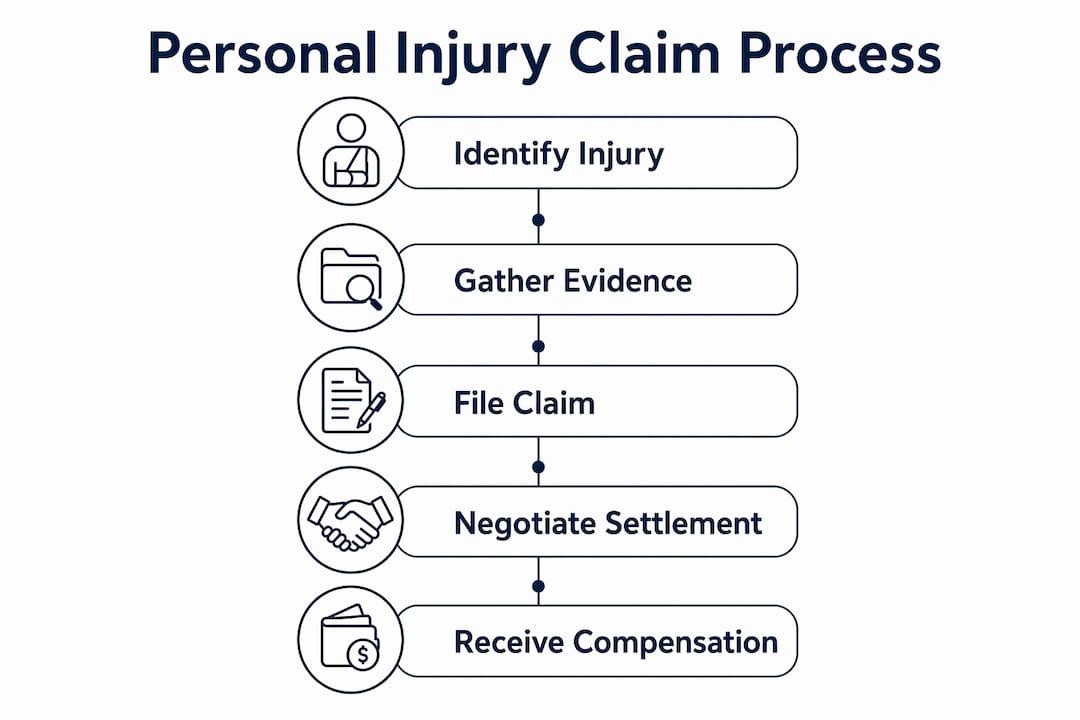
The personal injury claim process follows a predictable sequence, though the timeline varies by case. Here is how it typically unfolds:
- Seek medical treatment immediately. Your health comes first, and medical records from the start of your injury are critical evidence.
- Consult a personal injury attorney. Most work on a contingency fee basis, meaning no upfront cost to you. They only get paid if you win.
- File an insurance claim. This is usually the starting point. Your attorney handles communication with the insurer on your behalf.
- Gather evidence. This includes medical records, bills, wage loss documentation, photos, and witness statements.
- Negotiate a settlement. Your attorney presents your documented damages to the insurer. Insurance negotiations depend heavily on well-documented economic and non-economic losses.
- File a lawsuit if needed. If the insurer refuses a fair offer, your attorney files a formal complaint in civil court.
- Discovery and trial. Both sides exchange evidence. Most cases settle before trial, but some proceed to a jury verdict.
Most personal injury claims resolve within 12–18 months when settled before trial. Complex cases involving serious injuries, disputed liability, or multiple parties can take considerably longer. For a realistic look at how long your specific situation might take, the Wreckmatch accident claim timeline tool breaks it down by case type.
One deadline you cannot miss: the statute of limitations. Every state sets a time limit for filing a personal injury lawsuit. In most states, that window is two to three years from the date of injury. Miss it, and you lose your right to sue, regardless of how strong your case is. Formal court proceedings must be initiated within jurisdictional deadlines. Contacting an insurer alone does not stop the clock.
Pro Tip: Do not wait to consult an attorney. Evidence disappears, witnesses forget details, and deadlines are absolute. A free consultation costs you nothing and could protect everything.
What compensation can you recover from a personal injury claim?
Compensation in personal injury claims falls into two main categories: economic damages and non-economic damages. Both are legitimate, and both require documentation to maximize your recovery.
Economic damages are straightforward to calculate:
- Emergency room visits, surgeries, and ongoing medical treatment
- Physical therapy and rehabilitation costs
- Lost wages during recovery
- Future lost earning capacity if your injury is permanent
- Out-of-pocket expenses like transportation to medical appointments
Non-economic damages are harder to quantify but equally real:
- Pain and suffering
- Emotional distress and mental health treatment
- Loss of enjoyment of life (activities you can no longer do)
- Loss of companionship or consortium for spouses
"Clear documentation of damages bolsters negotiation leverage." Insurers respond to evidence. Vague claims of suffering without supporting records produce lower settlement offers. Keep a daily journal of your symptoms, limitations, and emotional state from the day of your injury forward.
Some states cap non-economic damages, particularly in medical malpractice cases. California, for example, has historically limited non-economic damages in malpractice claims. Your attorney will know the rules in your state and factor them into your strategy.
Understanding why personal injury cases settle before trial often comes down to this: both sides weigh the documented evidence against the cost and uncertainty of litigation. Strong documentation shifts that calculation in your favor.
Key takeaways
A personal injury claim succeeds when you prove four legal elements, document every loss, and act before the statute of limitations expires.
| Point | Details |
|---|---|
| Definition of the claim | A personal injury claim is a legal demand for compensation when another party's negligence causes you harm. |
| Four required elements | You must prove duty of care, breach, causation, and damages to win a negligence-based claim. |
| Types of qualifying incidents | Car accidents, slip and falls, medical malpractice, and product liability all qualify with different evidence rules. |
| Typical resolution timeline | Most claims settle within 12–18 months; complex cases take longer depending on evidence and court schedules. |
| Documentation drives outcomes | Detailed records of medical costs, lost wages, and daily impact directly increase your settlement value. |
What i've learned after years of watching these cases unfold
Most people who contact Wreckmatch after an accident are focused on the injury itself. That is understandable. But the cases that resolve well share one common trait: the injured person started building their evidence file early and got legal help fast.
The cases that struggle are almost always the ones where someone waited. They assumed the insurance company would be fair. They did not keep records. They missed a filing deadline by a few weeks. Those mistakes are permanent.
Here is the uncomfortable truth about personal injury claims: the legal system does not reward the most injured person. It rewards the person with the clearest proof. A well-documented minor injury can outperform a severe injury with weak evidence in settlement negotiations.
My advice is simple. Do not try to manage this alone. Attorneys who handle personal injury cases on contingency have every financial incentive to maximize your recovery. They cost you nothing unless you win. Use that resource. And start the process before you think you are ready, because the clock is already running.
— Scott
How Wreckmatch can help you move forward
If you were hurt in an accident and are not sure where to start, Wreckmatch was built for exactly this moment.

Wreckmatch connects injured people with experienced personal injury attorneys at no upfront cost. The matching process takes about 60 seconds, and you get a response fast. No confusion about who to call. No guessing whether you can afford help. Wreckmatch handles the connection so you can focus on recovery.
Start with the Accident Survival Guide to understand your rights and next steps after an accident. Or visit Wreckmatch directly to get matched with a licensed attorney in your state today. Free consultation. No obligation. Real help when you need it most.
FAQ
What is a personal injury claim in simple terms?
A personal injury claim is a legal request for financial compensation when someone else's negligence or wrongdoing causes you physical or psychological harm. It typically starts as an insurance claim and may become a lawsuit if a fair settlement is not reached.
How long does a personal injury claim take to resolve?
Most personal injury claims settle within 12–18 months, though complex cases involving serious injuries or disputed liability can take longer depending on court schedules and defense strategies.
What do i need to include in a personal injury claim?
Your claim should include medical records, bills, proof of lost wages, photos of the injury and scene, witness statements, and a record of how the injury has affected your daily life. Detailed documentation directly strengthens your settlement position.
Do i need a lawyer to file a personal injury claim?
You are not legally required to hire an attorney, but most personal injury lawyers work on contingency, meaning no upfront cost to you. Given that strong evidence and legal strategy significantly affect outcomes, professional representation is strongly recommended for any serious injury.
What is the deadline for filing a personal injury claim?
The statute of limitations varies by state but is typically two to three years from the date of injury. Missing this deadline means losing your right to sue, regardless of how strong your case is.