
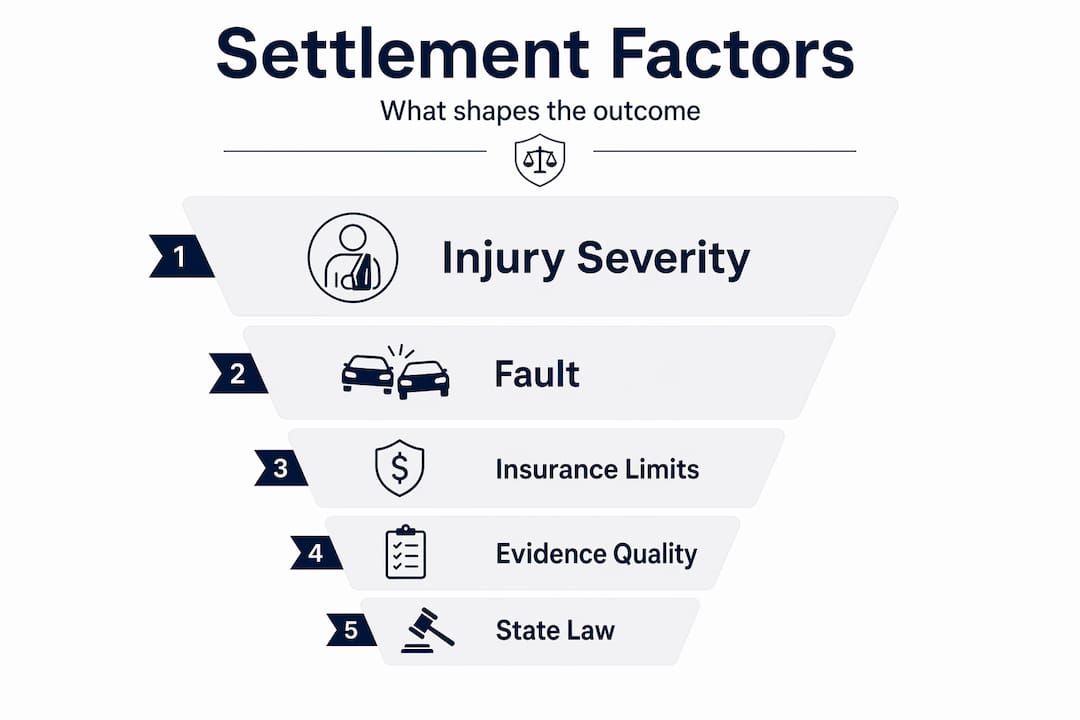
Two people walk away from what looks like the same type of collision. One receives $12,000. The other gets $180,000. No, that's not a mistake. That gap is exactly why car accident settlements vary widely, and why assuming your payout will match a friend's or a story you read online is one of the most costly mistakes you can make. Your settlement is shaped by a specific combination of injury severity, fault, insurance limits, evidence, and legal environment. Understanding each factor gives you a realistic picture of what your claim is actually worth.
Table of Contents
- Key takeaways
- Why car accident settlements vary widely
- How injury severity shapes your settlement
- Fault, comparative negligence, and what they cost you
- Insurance policy limits and settlement ceilings
- Evidence quality and its direct effect on what you receive
- Settlement timelines and how state law affects your payout
- My take on why most people underestimate this process
- Get free help understanding your settlement
- FAQ
Key takeaways
| Point | Details |
|---|---|
| Injury severity drives value | More serious, permanent injuries produce significantly higher settlements than minor soft tissue cases. |
| Fault percentage directly reduces your payout | Comparative negligence rules can cut or completely eliminate your compensation depending on your state. |
| Insurance limits cap what you can collect | The at-fault driver's policy ceiling often limits your recovery regardless of your actual damages. |
| Evidence quality changes insurer behavior | Strong, timely documentation pushes insurers toward higher offers; gaps in records do the opposite. |
| State law shapes the outcome | Damages caps, negligence rules, and local jury tendencies all shift what a fair settlement looks like. |
Why car accident settlements vary widely
The legal term for what you're pursuing after a crash is a personal injury claim or tort claim. Settlement is simply an agreement to resolve that claim without going to trial. The dollar amount attached to that agreement is not pulled from a formula. Settlement amounts vary widely due to a case-specific mix of injury severity, liability evidence, damages, and the at-fault driver's insurance coverage limits.
What makes this confusing for most people is that two accidents can look nearly identical on the surface and produce dramatically different financial outcomes. Same intersection. Same vehicle types. Same general story. But different injuries, different insurance policies, and different states can produce settlements that are not even in the same range. The rest of this article breaks down exactly why that happens and what it means for your case.
How injury severity shapes your settlement
Of all the factors that affect car accident settlement values, the nature and severity of your injuries carries the most weight. Insurers and attorneys both evaluate two categories of damages: economic and non-economic.
Economic damages are the costs you can document with a number:
- Current and future medical bills
- Lost wages from missed work
- Cost of ongoing physical therapy or rehabilitation
- Home care or mobility equipment if required
Non-economic damages are harder to quantify but often make up the largest portion of serious claims:
- Pain and suffering
- Emotional distress
- Loss of enjoyment of life
- Permanent disability or disfigurement
A person with soft tissue injuries, a few chiropractic visits, and a full recovery might settle for $8,000 to $25,000. A person with a traumatic brain injury, multiple surgeries, and permanent cognitive damage may have a claim worth seven figures. The gap is not unfair. It reflects the actual difference in what those injuries cost and how severely they alter a person's life.
Pro Tip: Never settle before your doctor says you've reached "maximum medical improvement." Settling too early means accepting a number based on incomplete injury information, and you cannot go back for more money once you sign a release.
Consistent treatment matters just as much as the diagnosis itself. Delayed or inconsistent medical treatment may cause insurers to argue your injuries aren't accident-related, which gives them grounds to reduce or deny your claim.
Fault, comparative negligence, and what they cost you
Liability, meaning who caused the crash and by how much, is the second major force behind car accident settlement discrepancies. Even if your injuries are serious, how much fault is assigned to you directly reduces what you can recover.
Most states follow comparative negligence rules, which assign a percentage of fault to each party. There are two main versions:
- Pure comparative negligence: You can recover damages even if you are 99% at fault, but your payout is reduced by your percentage of fault.
- Modified comparative negligence: Recovery is barred above 50% or 51% fault, depending on the state. If you're found 52% responsible, you collect nothing.
Here's a direct example of how fault allocation causes reasons for differing accident settlements:
| Scenario | Injury Value | Fault % (Victim) | Recovery |
|---|---|---|---|
| Clean liability, 0% fault | $100,000 | 0% | $100,000 |
| Partial fault, 30% | $100,000 | 30% | $70,000 |
| Barred in modified state | $100,000 | 52% | $0 |
Police reports, witness statements, traffic camera footage, and accident reconstruction reports all feed into the fault determination. Liability evidence including police reports and witnesses significantly affects insurer risk calculations and how much they're willing to offer at the negotiating table.

Pro Tip: Even if you think you were partially at fault, do not admit responsibility at the scene or to an insurance adjuster. Let the evidence determine fault rather than your words in a stressful moment.
Insurance policy limits and settlement ceilings
Here's a reality many accident victims don't discover until it's too late: the at-fault driver's insurance policy sets a ceiling on what their insurer will pay, regardless of how serious your injuries are. Insurance policy limits cap insurer payouts, which means you may only recover up to those limits even when your actual damages are far higher.
Policies typically have two numbers: a per-person limit and a per-accident limit. A common minimum policy looks like $25,000 per person and $50,000 per accident. If your medical bills alone are $80,000, that $25,000 cap becomes a serious problem.
Your options in that situation include:
- Underinsured motorist (UIM) coverage: If you carry this on your own policy, it can cover the gap between the at-fault driver's limit and your actual damages.
- Additional liable parties: Employers of drivers on the job, vehicle manufacturers in defect cases, or government entities responsible for road conditions may also share liability.
- Personal assets: In rare cases, you can pursue the at-fault driver's personal assets, though this is often impractical.
Mapping all recovery sources including underinsured motorist coverage is critical when the at-fault driver's policy limits are low. Most accident victims don't know to ask about this, which is one reason why seeking legal advice leads to significantly higher average settlements.
Pro Tip: Pull out your own auto insurance policy and find your UIM coverage limits today. If you don't have UIM coverage or your limits are low, talk to your agent before your next renewal. It's one of the most affordable and overlooked protections available.
Evidence quality and its direct effect on what you receive
Insurance companies do not simply take your word for what happened or how badly you were hurt. They evaluate risk. Specifically, they calculate the probability that your case would succeed at trial and what a jury might award. Insurer offers are based on perceived trial risk, which is why evidence quality causes variations in auto accident compensation even between similar cases.
Strong evidence pushes that risk assessment in your favor. Weak or missing evidence gives the insurer room to dispute your claim and justify a lower offer.
What insurers look for:
- Complete and consistent medical records from the date of the crash forward
- Photos of vehicle damage, road conditions, and your visible injuries
- Official police report with a clear narrative
- Statements from independent witnesses
- Any available surveillance or dashcam footage
Evidence quality and consistency directly influence settlement amounts. A gap of even a few weeks in your medical treatment can be framed by an insurer as evidence that you weren't seriously hurt or that your ongoing symptoms aren't related to the crash.
Common mistakes that reduce settlement offers include waiting days or weeks to see a doctor after a crash, missing physical therapy appointments, failing to photograph vehicle damage at the scene, and not keeping a written log of how pain affects your daily life. That log, often called a pain journal, is inexpensive to maintain and can be genuinely persuasive.
Pro Tip: Start a pain journal the day of your accident. Write two or three sentences daily about your pain levels, activities you can't do, and how your injuries are affecting sleep, work, and relationships. This creates a personal record that supports your non-economic damage claims.
Settlement timelines and how state law affects your payout
How long a settlement takes, and where you live, both influence how car accident claims are valued in your specific situation.
Minor injury claims often settle within months, while serious or disputed claims typically take one to two years or more. This isn't just bureaucratic delay. Waiting for medical stability matters because settlement negotiations hinge on when doctors can credibly describe permanent impairment and future treatment needs. Valuing a claim too early risks leaving significant money on the table.
| Settlement timeline | Typical case type |
|---|---|
| 1 to 3 months | Minor injuries, clear liability, no disputes |
| 3 to 9 months | Moderate injuries, some liability issues |
| 9 months to 2 years | Serious injuries, disputed liability, litigation possible |
| 2 or more years | Catastrophic injuries, complex litigation, trial |
State law also drives notable settlement variations across jurisdictions. Some states cap non-economic damages in personal injury cases. Others have contributory negligence rules that completely bar recovery if you share any fault at all. Local jury tendencies matter too. A case filed in a plaintiff-friendly jurisdiction may settle higher simply because the insurer knows a local jury would award more at trial.
You can check state-specific rules that affect your claim, including fault standards and damages caps for your jurisdiction.
Pro Tip: Don't accept an early settlement offer before you know your full diagnosis and prognosis. The insurer's first offer reflects their best case scenario, not yours. Getting a full medical picture first almost always produces a higher number.
My take on why most people underestimate this process
I've watched people accept settlement offers that were a fraction of what their case was worth, and the reason is almost always the same. They assumed the process was simpler than it is.
The uncomfortable truth is that insurance adjusters are trained negotiators working for a company whose goal is to pay as little as possible. They are not your advisor. They may seem friendly and helpful, but their job is to close your claim at the lowest defensible number.
What I've seen repeated again and again: people with serious injuries who could document everything walked away with fair compensation. People with equally serious injuries and poor documentation accepted low offers because they couldn't prove the full picture. The claim isn't just about what happened to you. It's about what you can show happened to you.
My honest advice? Don't try to navigate this alone. Attorneys handling personal injury claims understand exactly what evidence to gather, when to hold out, and when a settlement offer is genuinely reasonable. The cost of not knowing that difference can be enormous.
Patience also matters. I know it's emotionally draining to have an open claim hanging over your life for months or years. But rushing a settlement almost always means leaving money behind. Take the time to understand your case's full value before you sign anything.
— Scott
Get free help understanding your settlement
Understanding why your settlement may look different from someone else's is just the first step. Knowing what to do next is where it gets real.
WreckMatch connects accident victims with experienced personal injury attorneys at no upfront cost. There's no fee to get matched, and attorneys in the network work on contingency, meaning they only get paid if you win. Whether you need help understanding your claim's value, want to review a claim timeline, or simply want to talk to someone who knows personal injury law in your state, WreckMatch makes that connection fast and free. Don't let confusion or uncertainty cost you money you're entitled to. Visit WreckMatch now and get matched with a licensed attorney in your area.
FAQ
What is the biggest factor affecting my car accident settlement?
Injury severity is the single most significant factor. More serious, permanent injuries with extensive medical costs and long-term impact on daily life produce far higher settlements than minor injuries that resolve quickly.
Why did my neighbor get more money for a similar accident?
Differences in fault allocation, injury severity, insurance policy limits, evidence quality, and state law all affect payouts. Two accidents that look identical on the surface can produce very different outcomes based on these variables.
Can I still recover money if I was partly at fault?
In most states, yes. Under comparative negligence rules, your payout is reduced by your percentage of fault. However, in modified comparative negligence states, recovery is barred if you are found 50% or 51% or more at fault, depending on the state.
How long does a car accident settlement usually take?
Minor claims with clear liability can settle in one to three months. Serious injuries with disputed facts often take nine months to two years or longer, particularly when litigation becomes necessary.
Does hiring an attorney really change my settlement amount?
Yes. Studies show that accident victims who seek legal advice receive significantly higher settlements on average than those who handle claims on their own, largely because attorneys understand how to document, value, and negotiate claims effectively.
Recommended
- How Much Is My Car Accident Case Worth in 2026? | WreckMatch Blog | WreckMatch
- How Long Does a Car Accident Settlement Take in San Antonio? (2026) | WreckMatch Blog | WreckMatch
- How Long Does a Car Accident Settlement Take in Houston? (2026) | WreckMatch Blog | WreckMatch
- Car Accident Lawyer Referral in Texas | WreckMatch | WreckMatch