
Most people assume hiring an attorney means giving up a chunk of their settlement. That assumption costs injured people real money every day. The truth is that understanding why hire personal injury attorney matters comes down to one number: 3.5 times larger settlements net of fees for represented clients compared to those who go it alone. If you were recently hurt in an accident, this article breaks down exactly what an attorney does, what it costs, and why the math almost always works in your favor.
Table of Contents
- Key Takeaways
- Why hiring a personal injury attorney puts more money in your pocket
- Understanding contingency fees and the real cost of hiring help
- Timing matters: why you should hire a lawyer right away
- Disputed claims and complex cases: what attorneys actually investigate
- What working with a personal injury attorney actually looks like
- My honest take on why waiting costs you more than hiring does
- Get connected with a personal injury attorney through Wreckmatch for free
- FAQ
Key Takeaways
| Point | Details |
|---|---|
| Attorneys increase net settlements | Represented injury victims recover about 3.5x more after fees than those without legal help. |
| No upfront cost required | Personal injury attorneys work on contingency, meaning you pay nothing unless you win. |
| Early hiring protects evidence | The first two weeks after an accident are critical for capturing evidence that builds your case. |
| Attorneys handle insurer tactics | Legal counsel shields you from damaging statements and manages all communications with adjusters. |
| Deadlines can kill your claim | Missing your state's statute of limitations permanently bars recovery, making early action non-negotiable. |
Why hiring a personal injury attorney puts more money in your pocket
Here is the misconception that trips up injured people most often. They see a 33% contingency fee and think: "I will net more by keeping the whole thing." The math does not work that way.
Insurance Research Council data accumulated over decades consistently shows that injury victims with attorney representation receive settlements roughly 3.5 times larger net of fees than unrepresented victims. That gap exists because attorneys know how to calculate and document damages that most people never think to claim.
Here is what most people miss when valuing their own claim:
- Future medical costs — not just your current bills, but projected surgeries, therapy, and long-term care
- Lost earning capacity — if your injuries reduce what you can earn over your lifetime, that loss is compensable
- Pain and suffering — a category insurers routinely lowball without legal pressure
- Medical lien reductions — lien reductions of 30% to 60% are achievable by skilled attorneys, saving thousands that unrepresented clients never recover
That last point alone changes the math significantly. When an attorney reduces a $20,000 medical lien down to $9,000, that $11,000 difference goes directly into your pocket regardless of the fee structure.
Attorneys also carry what is called litigation threat leverage. Trial experience changes an insurer's risk calculation. When the adjuster knows your attorney takes cases to verdict, low settlement offers carry real consequences for the insurer. That credibility alone moves numbers.
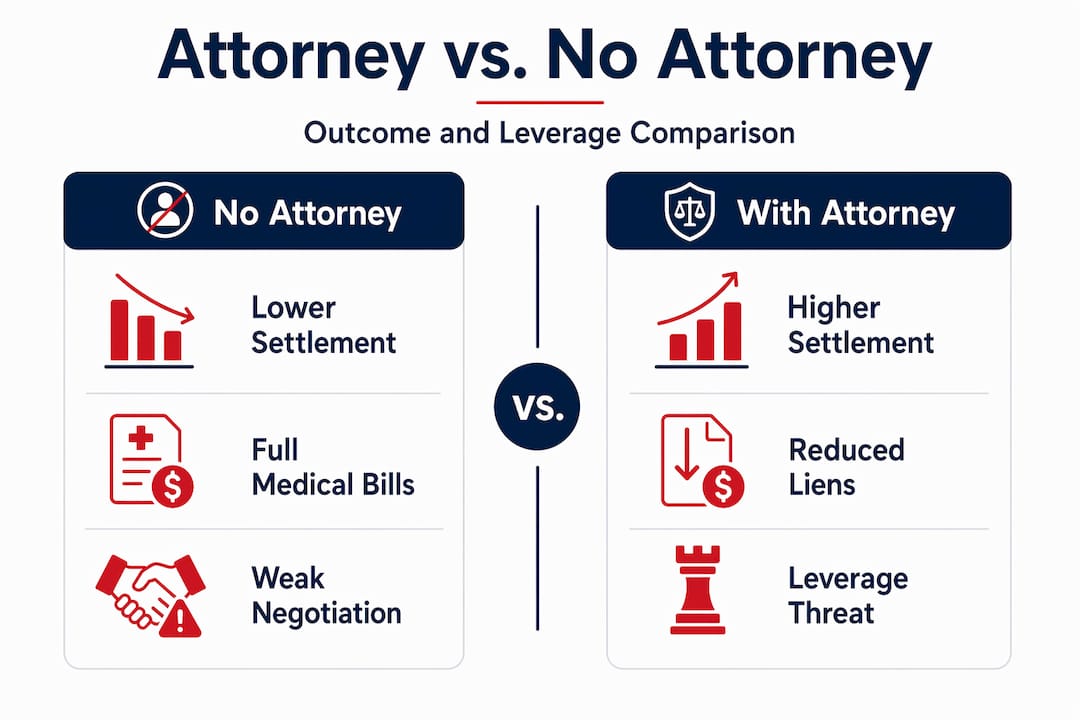
Pro Tip: Ask any attorney you consult whether they have taken similar cases to trial. An attorney who settles everything without exception carries less negotiating leverage than one who will genuinely go to court when needed.
Understanding contingency fees and the real cost of hiring help
The words "no upfront cost" are not a marketing phrase. They describe how personal injury legal help actually works. You pay nothing to hire an attorney, nothing during your case, and nothing if you lose.
Most attorneys charge about 33% before litigation begins and up to 40% if the case goes to trial. Here is what that looks like side by side.
| Scenario | No attorney | With attorney (33%) |
|---|---|---|
| Settlement offer | $30,000 | $90,000 |
| Attorney fee | $0 | $29,700 |
| Medical liens paid | $20,000 | $8,000 (negotiated down) |
| Net recovery | $10,000 | $52,300 |
The difference is not subtle. A higher gross settlement with fees often nets five times more than what you would accept on your own.
It also helps to understand that contingency fees democratize access to the legal system. Before this model existed, only people who could afford hourly billing had access to experienced civil litigation attorneys. The contingency model means your attorney's financial interest is perfectly aligned with yours. They earn more only when you earn more.
One important distinction: attorney fees and case expenses are separate. Expenses like filing fees, expert witness costs, and medical record retrieval may be deducted from the settlement in addition to the percentage fee. Ask your attorney upfront how expenses are handled.
Pro Tip: Always get your fee agreement in writing before signing anything. A transparent attorney will explain every line of the contingency contract before you commit.
Timing matters: why you should hire a lawyer right away
Most people wait. They think the injury needs to resolve first, or they want to see what the insurance company offers. Both approaches actively damage your claim.

The first one to two weeks after an accident are a vital evidence window. Witnesses' memories fade fast. Surveillance footage gets overwritten. Skid marks disappear. Physical evidence at the scene changes or gets cleaned up. An attorney who gets involved early can dispatch investigators, preserve footage, and secure witness statements while the details are still fresh.
Beyond evidence, early hiring protects you from critical legal mistakes:
- Recorded statements — insurers often request recorded statements early in the process, and anything you say can be used to minimize or deny your claim
- Statute of limitations — missing the filing deadline, such as Illinois's two-year window, permanently bars your claim with no exceptions
- Early settlement traps — insurers sometimes offer quick settlements before you know the full extent of your injuries; accepting too soon waives your right to future compensation
- Maximum medical improvement — settling before reaching this milestone risks undervaluing your claim because your full treatment costs are not yet known
Check your state's filing deadlines for accidents before assuming you have plenty of time. Some states have shorter windows than you expect, and certain defendants like government entities may require notice within 30 to 90 days.
Disputed claims and complex cases: what attorneys actually investigate
When the other driver's insurer denies fault, or when your injuries are serious enough to attract aggressive defense tactics, going alone becomes genuinely risky.
- Accident reconstruction — attorneys retain experts who analyze crash physics, vehicle damage, and roadway conditions to establish fault when it is disputed
- Medical expert testimony — linking your injuries directly to the accident requires documented expert opinions, especially for injuries that develop over days or weeks after the crash
- Employment records and vocational experts — proving lost earning capacity requires more than a pay stub; attorneys compile employment history, expert opinions, and medical projections
- Insurer defense counters — insurers may argue you failed to mitigate your damages; attorneys proactively document medical necessity and treatment compliance to shut down that defense before it starts
- Third-party liability — serious crashes, especially truck accidents, may involve multiple at-fault parties including employers, vehicle manufacturers, or government road maintenance entities
Larger injury claims attract more aggressive insurance defenses by design. The more money at stake, the harder insurers push back. An experienced attorney has seen every tactic in the playbook and knows how to respond with documented, credible evidence rather than emotion.
One thing rarely discussed: attorneys also build a paper trail that makes your version of events undeniable. It is not just your word against the insurer's. It is your word backed by reconstruction experts, medical professionals, employment specialists, and photographic evidence organized into a documented claim file.
What working with a personal injury attorney actually looks like
The personal injury claims process can feel uncertain if you have never been through it before. Here is what to expect:
- Free consultation — most attorneys offer a no-cost review of your situation with zero obligation to hire
- Case intake and investigation — your attorney gathers accident reports, medical records, photos, witness contact information, and insurance policy details
- Demand letter — once your treatment is complete or you reach maximum medical improvement, your attorney sends a formal demand to the insurer with full documentation of damages
- Negotiation — attorneys act as a buffer between you and the adjuster; you are not required to speak with insurance representatives directly
- Settlement or litigation — most cases settle before trial; if the insurer refuses a fair offer, your attorney prepares to file suit
- Disbursement — after settlement, your attorney pays liens, deducts fees and expenses, and sends your net check with a full accounting
Transparency matters throughout this process. A trustworthy attorney updates you at each stage and explains every deduction before funds are distributed. You should never receive a check without a clear breakdown of where every dollar went.
If you are unsure whether to speak with an adjuster before retaining legal help, read about talking to adjusters first before you say anything on record.
My honest take on why waiting costs you more than hiring does
I have watched hundreds of injury victims go through this process. The ones who wait almost always regret it. Not because attorneys are miracle workers, but because time destroys the building blocks of a strong claim.
The biggest mistake I see is people spending three months negotiating with an adjuster only to find out they were never going to get a fair offer without litigation on the table. By then, key evidence is gone. Witnesses can no longer be reached. The insurer has a recorded statement that creates problems.
Here is what actually surprises people once they work with an attorney: the fee math. Most clients expect to net less. Almost every single one nets significantly more. The fear that hiring a lawyer lowers net settlement is mathematically incorrect in the vast majority of cases.
My take: if your injuries required a doctor visit, lost you any time at work, or caused any ongoing pain, the advantages of hiring an attorney outweigh doing nothing. The consultation is free. The risk of not calling is not.
— Scott
Get connected with a personal injury attorney through Wreckmatch for free
You do not need to figure out the legal system alone after an accident. Wreckmatch was built specifically to remove the confusion from finding trusted legal help fast.
Through Wreckmatch's free referral service, you can get connected with a licensed personal injury attorney in your area at no upfront cost. No fees to match. No obligation after your free consultation. The process takes about 60 seconds to start.
If you were hurt in a wreck, you can find attorney referrals by state to locate experienced legal help near you. Wreckmatch uses fast-response intake support to match you with law firms equipped to handle your specific claim type, whether it is a car accident, truck crash, or multi-vehicle collision.
You pay nothing out of pocket to get matched, and the attorneys in Wreckmatch's network work on contingency. You owe nothing unless you win.
** Get free legal help now at wreckmatch.com — no upfront cost, no obligation.**
FAQ
How much more do you recover with a personal injury attorney?
Injury victims with attorney representation receive settlements about 3.5 times larger net of fees than unrepresented victims, based on decades of Insurance Research Council data.
What does a personal injury attorney cost upfront?
Nothing. Personal injury attorneys work on contingency, typically charging 33% before litigation or up to 40% if the case goes to trial, and you pay only when you receive a settlement or verdict.
When should you hire a personal injury lawyer?
Hire one as soon as possible after your accident. The first two weeks are a critical evidence window, and early attorney involvement protects you from damaging insurer statements and missed legal deadlines.
Can an attorney really protect you from insurance adjusters?
Yes. Legal counsel acts as a buffer between you and the insurer, managing all communications and preventing you from making recorded statements that could hurt your claim.
What happens if you miss the statute of limitations?
Missing the deadline permanently bars your personal injury claim. Deadlines vary by state, with some as short as one to two years, making early legal advice non-negotiable after any serious accident.