
Rideshare accident victims need attorneys because Uber and Lyft accidents involve layered insurance policies, multiple liable parties, and corporate legal teams specifically trained to minimize what you receive. The legal framework governing these crashes, formally called transportation network company (TNC) liability law, is far more complex than a standard car accident claim. Insurance coverage shifts based on the driver's app status at the exact moment of the crash. Without an attorney who understands TNC regulations, you risk accepting a fraction of what your claim is actually worth.
Why rideshare accident victims need attorneys: the insurance problem
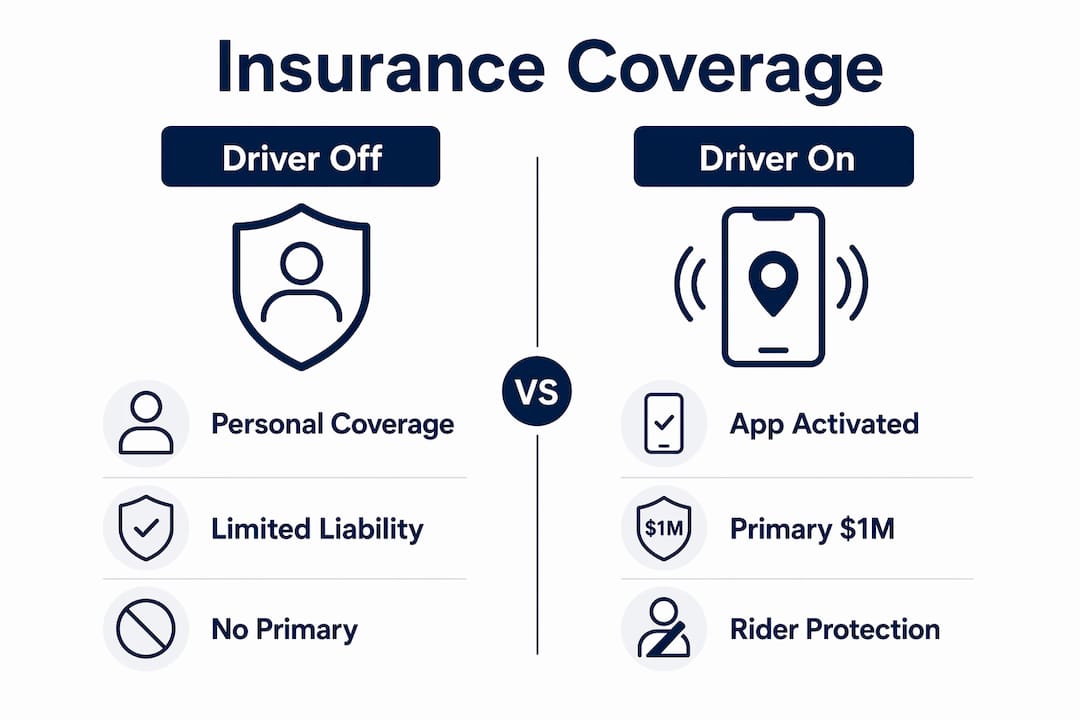
Rideshare accident insurance coverage does not work like a standard auto policy. Coverage depends entirely on which of three phases the driver was in when the crash occurred, and each phase carries dramatically different policy limits.
| Driver status | Coverage available |
|---|---|
| App off (personal driving) | Driver's personal auto insurance only |
| App on, no ride accepted | Limited contingent liability ($50K–$100K typical) |
| Active ride or passenger onboard | $1 million primary liability coverage |
Rideshare companies provide tiered insurance with $1 million in primary liability applying only during Period 3, when a ride is accepted or a passenger is in the vehicle. That gap between a $50,000 limit and a $1 million limit is not a technicality. It is the difference between covering your medical bills and covering your long-term recovery.

The problem is that misidentifying the driver's app status at the time of the crash can result in a $30,000 versus $1 million policy limits difference. Rideshare companies and their insurers have every incentive to argue the driver was in a lower-coverage phase. An attorney pulls the trip data, GPS records, and driver activity logs to prove exactly which phase applied.
Pro Tip: Request a copy of the police report immediately after your accident. It often records whether the driver stated they were on a trip, which supports the higher-coverage period argument.
Understanding rideshare accident claims requires knowing which insurer to pursue and in what order. Attorneys who specialize in TNC cases know this process. General personal injury lawyers often do not.
What challenges do victims face without an attorney?
Going up against Uber or Lyft without legal representation puts you at a serious disadvantage from day one. These companies employ dedicated legal teams and adjusters whose sole purpose is to minimize payouts. You are not negotiating with a neutral party. You are negotiating against professionals who do this every day.
Here is what victims routinely face without legal help:
- Lowball early settlement offers. Insurers often contact victims within days of the crash with a fast settlement offer. Accepting it typically waives your right to pursue further compensation, even if your injuries worsen.
- Recorded statement requests. Adjusters ask for recorded statements early, before you fully understand your injuries. Statements made without counsel can be used to contradict your claim later.
- Disputed liability. Rideshare companies classify drivers as independent contractors to limit their own liability. This classification creates a legal gray area that adjusters exploit to shift blame away from the company.
- Jurisdictional traps. States like Minnesota require victims to meet a $4,000 medical expense threshold, and Florida requires a $10,000 PIP minimum before pursuing third-party claims. State-specific thresholds can bar your claim entirely if you do not know they exist.
- Missed deadlines. Statutes of limitations vary by state and claim type. Missing a filing deadline ends your case permanently, regardless of how strong it is.
Each of these obstacles is manageable with the right attorney. Without one, any single item on this list can collapse your claim.
How do specialized rideshare attorneys maximize your compensation?
A specialized rideshare attorney does not just file paperwork. They build a case designed to pressure insurers into paying full value, and they prepare for trial if the insurer refuses. Here is how that process works in practice:
- Secure digital evidence immediately. Attorneys send preservation letters to Uber or Lyft within days of the crash, demanding that trip data, GPS logs, and driver activity records be preserved. This evidence disappears quickly without legal action to protect it.
- Confirm the correct insurance phase. Using app activity logs and dispatch records, attorneys preserve digital evidence to confirm exactly which coverage period applied. This single step can multiply the available policy limits.
- Build a trial-ready file. Trial-ready claim preparation results in higher settlement offers because insurance adjusters know the victim is prepared to litigate. A well-documented file with accident reconstruction reports, medical records, and expert testimony changes the insurer's calculus entirely.
- Navigate TNC-specific regulations. Specialized rideshare attorneys understand state TNC regulations and layered insurance policies that general personal injury lawyers may overlook. This expertise directly affects whether your claim succeeds or gets denied on a technicality.
- Negotiate commercial policy limits. Active-ride crashes involve commercial insurance policies with limits up to $1 million. Attorneys experienced in commercial negotiations know how to pursue the full amount rather than accepting the first offer.
Pro Tip: Do not post anything about your accident on social media. Insurance adjusters monitor accounts and use photos or statements to argue your injuries are less severe than claimed.
Getting Uber and Lyft accident help from a specialist early in the process preserves your strongest evidence and prevents the mistakes that weaken cases later.
What do rideshare attorneys cost, and can you afford one?
The most common reason victims avoid hiring an attorney is the assumption that legal help is expensive. In rideshare accident cases, that assumption is wrong. Most rideshare accident attorneys work on contingency fees, typically 33% pre-litigation and up to 40% after a lawsuit is filed, with no upfront costs to you.
Here is what that fee structure means in practice:
- You pay nothing to start. No retainer, no hourly rate, no consultation fee. You get legal representation from day one at zero out-of-pocket cost.
- Your attorney only gets paid if you win. This aligns the attorney's financial interest directly with maximizing your compensation. They have no incentive to settle fast and cheap.
- Fees come from the settlement. The contingency percentage is deducted from the final award, not billed separately. If your case results in $200,000, a 33% fee means you receive approximately $134,000 after attorney fees.
- You get access to resources you could not afford alone. Attorneys front the cost of accident reconstruction experts, medical record retrieval, and expert witnesses. These resources significantly strengthen your claim.
The contingency model exists specifically to give injured people access to experienced legal representation regardless of their financial situation. You do not need savings or credit to get help. You need a strong case, and a good attorney will tell you honestly whether you have one.
Key takeaways
Rideshare accident victims who hire specialized TNC attorneys recover more compensation because attorneys secure critical digital evidence, identify the correct insurance phase, and prepare trial-ready claims that pressure insurers to pay full value.
| Point | Details |
|---|---|
| Insurance phases determine coverage | The driver's app status at crash time controls whether limits are $50K or $1 million. |
| Corporate teams work against you | Rideshare companies use dedicated legal staff and adjusters to minimize every payout. |
| Evidence disappears fast | Attorneys send preservation letters immediately to protect GPS and app activity data. |
| Contingency fees remove cost barriers | You pay 33% to 40% only if you win, with zero upfront costs to start your case. |
| Specialized knowledge wins cases | General injury attorneys often miss TNC regulations that determine claim success or denial. |
The mistake I see victims make most often
I have spent years watching how rideshare accident cases unfold, and the single most damaging mistake victims make is waiting. Not waiting weeks. Waiting days. By the time someone calls for legal help, they have already given a recorded statement to an adjuster, accepted a preliminary offer, or posted something on Instagram that the insurer screenshots and uses against them.
The second mistake is assuming any personal injury attorney can handle a rideshare case. TNC law is genuinely specialized. The insurance phase analysis alone requires someone who knows how to pull and read app activity logs, understands how Uber and Lyft structure their commercial policies, and knows the specific TNC statutes in your state. I have seen cases where a victim hired a general injury attorney who missed the Period 3 coverage entirely and settled for $50,000 on a claim worth ten times that amount.
The attorneys who get the best outcomes in these cases treat them like commercial litigation from day one. They do not wait to see if the insurer plays fair. They build the file, send the preservation letters, and make clear they are ready for trial. That posture alone changes what insurers offer.
If you are reading this after a rideshare crash, the most useful thing you can do right now is talk to a specialized attorney before you talk to any adjuster again. That conversation is free. The mistake of skipping it is not.
— Scott
Get matched with a rideshare accident attorney for free
If you were injured in an Uber or Lyft accident, Wreckmatch connects you with experienced personal injury attorneys who handle rideshare cases specifically. No upfront cost. No confusion about who to call.
Wreckmatch uses fast-response intake technology to match you with a licensed attorney in your area who understands TNC insurance phases, commercial policy limits, and the evidence preservation steps that protect your claim. You can also access the accident claim timeline and legal glossary to understand exactly where your case stands. Start with the free attorney matching service at Wreckmatch and get the legal help your situation requires.
FAQ
Why do rideshare accident claims require a specialist attorney?
Rideshare claims involve TNC-specific insurance phases, independent contractor classifications, and state regulations that general personal injury attorneys often miss. Specialized rideshare attorneys understand layered commercial policies and app data analysis that directly determine claim value.
What insurance coverage applies after a rideshare accident?
Coverage depends on the driver's app status at the time of the crash. Period 3, when a ride is active or a passenger is onboard, triggers $1 million in primary liability from Uber or Lyft's commercial policy.
How much does a rideshare accident attorney cost?
Most rideshare attorneys charge contingency fees of 33% pre-litigation and up to 40% after filing, with no upfront costs. You pay nothing unless your attorney wins compensation for you.
Should I give a recorded statement to the insurance adjuster?
No. Giving a recorded statement without an attorney present is one of the most common ways victims weaken their own claims. Adjusters use your words to dispute injury severity or shift liability.
How soon should I contact an attorney after a rideshare accident?
Contact an attorney as soon as possible, ideally within 24 to 48 hours. Early legal help preserves critical digital evidence like GPS data and app logs that disappear quickly without a formal preservation request.