
The accident settlement negotiation process is a structured sequence of steps that allows injury victims to secure fair compensation from an insurer or at-fault party without going to trial. Most personal injury claims resolve through this process, not in a courtroom. Understanding each phase, from your first demand letter to the final release document, puts you in control of your outcome and protects you from costly mistakes.
What are the key phases of the accident settlement negotiation process?
The accident claims process follows a predictable sequence, even when individual timelines vary. Knowing where you are in that sequence helps you make smarter decisions at every turn.
The four core phases are:
- Initial reporting. You report the accident to your insurer and the at-fault party's insurer. Preserve all evidence: photos, police reports, and witness contact information.
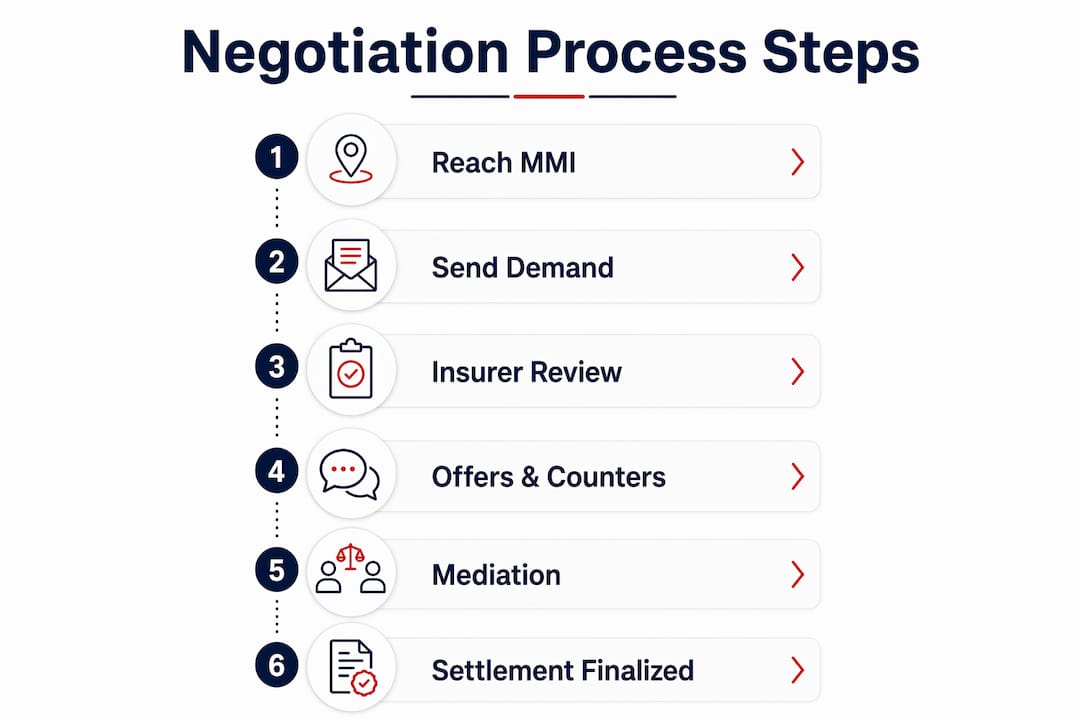
- Medical treatment. You receive treatment and document every visit, diagnosis, and bill. This phase ends when you reach Maximum Medical Improvement, or MMI. MMI is the point at which your condition has stabilized and further significant recovery is unlikely.
- Claim preparation and demand letter. Once you reach MMI, your attorney or you compile all records and send a formal demand letter to the insurer. This letter opens negotiations.
- Settlement negotiations. Offers and counteroffers go back and forth. If no agreement is reached, litigation becomes the next option. Claim phases range from day one of the accident to one to three or more years if a lawsuit is filed.
The MMI milestone is not optional. Settling before MMI risks permanently capping your recovery before you know the full cost of your injuries. Future surgeries, physical therapy, and lost earning capacity all need to be factored in before you agree to any number.
Pro Tip: Ask your treating physician directly: "Have I reached maximum medical improvement?" Get that answer in writing before you authorize anyone to negotiate on your behalf.
Negotiations themselves typically span weeks to months. Complex cases involving serious injuries, disputed liability, or multiple parties take longer. Simple soft-tissue claims with clear liability can resolve in as little as four to six weeks after the demand letter is sent.
How to prepare effectively for settlement negotiations
Preparation is where most victims either win or lose their case before a single offer is made. Strong preparation means you walk into negotiations with documented facts, not just a story.
Gather these items before sending any demand letter:
- Medical records and bills from every provider who treated your injuries
- The police accident report and any citations issued
- Photographs of vehicle damage, the scene, and your visible injuries
- Proof of lost wages from your employer, including pay stubs and a letter confirming missed work
- Out-of-pocket expense receipts for transportation, prescriptions, and medical equipment
- Expert opinions if your injuries are severe, such as a life care planner's projection of future costs
The demand letter is the single most important document in your claim. It formally opens negotiations and sets the anchor for every offer that follows. A well-built demand letter includes a clear statement of liability, a summary of your injuries and treatment, itemized economic damages like medical bills and lost wages, and a figure for non-economic damages like pain and suffering. Demand letters with strong evidence lead to stronger counteroffers. Weak, vague demands invite low-ball responses.
Timing matters here. Send the demand letter only after you have reached MMI and received all final medical bills. Sending it too early means you may undervalue future costs. Sending it too late can create unnecessary delays.
Pro Tip: If you are unsure whether to hire an attorney, consider this: personal injury attorneys work on contingency, meaning no upfront cost to you. They only get paid if you win. For serious injuries, that arrangement almost always results in a higher net recovery, even after the attorney's fee.
Working with a personal injury attorney also changes how insurers respond. Aligning on process details early, such as whether to use a mediator and who handles communications, increases the perceived fairness of the outcome for both sides.
What happens during the negotiation phase: offers, counteroffers, and tactics
Once your demand letter arrives, the insurer assigns an adjuster to evaluate your claim. Insurers typically respond within 30 to 90 days with an initial counteroffer that is often substantially below your demand. That low number is not a final answer. It is the start of a conversation.

Here is how the back-and-forth typically plays out:
| Stage | What happens |
|---|---|
| Demand letter sent | You set the opening anchor with full documentation |
| Insurer's first counteroffer | Usually well below demand; signals willingness to negotiate |
| Your counteroffer | You respond with a reduced but still firm number, citing specific evidence |
| Middle rounds | Both sides narrow the gap over 3 to 5 rounds |
| Agreement or impasse | Either a number is reached or litigation is considered |
Negotiations typically include 3 to 5 rounds of offer and counteroffer over weeks or months. Each round should be documented in writing. Verbal agreements over the phone carry no legal weight and give adjusters room to walk back commitments.
Insurers use specific tactics to reduce payouts. Watch for these:
- Delay tactics. Adjusters go quiet for weeks, hoping you grow impatient and accept less.
- Recorded statements. They ask you to give a recorded statement early, before you know the full extent of your injuries. You are not required to provide one.
- Minimizing injuries. They argue your injuries were pre-existing or not caused by the accident.
- Early settlement pressure. Early offers aim to minimize insurer risk by settling before your full medical costs are known.
The best counter to all of these is written documentation. Written demand letters create a paper trail that makes your claim concrete and harder to informally dismiss. When you communicate in writing, adjusters cannot later claim they misunderstood your position.
For complex claims or when negotiations stall, a mediator can break the deadlock. Mediation is a structured session where a neutral third party helps both sides find common ground. It is not binding, but it often produces agreements that direct negotiation cannot.
How is a settlement finalized and what happens after agreement?
Reaching a number is not the finish line. The settlement must be properly documented before any money changes hands.
Once both sides agree on a figure, the insurer drafts a settlement agreement and release. This document is legally binding and permanent. Signing it means you give up the right to pursue any further claims related to this accident, regardless of what happens to your health afterward. Read every word before you sign.
| Step | Timeline |
|---|---|
| Verbal agreement reached | Day 0 |
| Release document drafted and reviewed | 3 to 10 days |
| Signed release returned to insurer | Day 10 to 14 |
| Insurer issues payment | 10 to 30 days after signed release |
| Liens and bills resolved, net funds to client | 6 to 12 weeks from settlement date for represented cases |
If you have an attorney, the check goes into a lawyer's trust account first. From there, medical liens, health insurance subrogation claims, and attorney fees are paid before you receive your net amount. This process takes time, but it protects you from creditors coming after you directly later.
The release language deserves special attention. Broad releases cover all claims, known and unknown. If your attorney negotiates a narrower release, it may protect you if complications arise from your injuries later. This is one area where having legal representation pays for itself.
Common mistakes and settlement negotiation tips to maximize your compensation
Most victims leave money on the table not because they negotiated badly, but because they made avoidable mistakes before negotiations even started.
Avoid these errors:
- Settling before MMI. You cannot accurately value future medical costs until your condition stabilizes. Settling early is the single most common and costly mistake in personal injury negotiations.
- Accepting the first offer. The first counteroffer from an insurer is a negotiation tactic, not a fair assessment. Always counter.
- Relying on phone conversations. Verbal discussions with adjusters are not binding and can be misrepresented. Put everything in writing.
- Giving recorded statements without counsel. Anything you say can be used to reduce your payout. Consult an attorney before agreeing to any recorded interview.
- Ignoring non-economic damages. Pain and suffering, emotional distress, and loss of enjoyment of life are real damages. Document them in a personal injury journal from day one.
Pro Tip: Keep a daily journal after your accident. Write down your pain levels, activities you cannot do, and how your injuries affect your relationships and work. This journal becomes powerful evidence for non-economic damages during negotiations.
When negotiations stall completely, litigation is a legitimate option. Filing a lawsuit does not mean you go to trial. Most cases settle after a lawsuit is filed, often because the threat of litigation motivates insurers to make a serious offer. Talk to a personal injury attorney before deciding whether to pursue that path.
For a deeper look at managing adjuster communication throughout this process, the insurance adjuster guide at WreckMatch covers the specific strategies that work.
Key takeaways
Winning the accident settlement negotiation process requires reaching MMI before negotiating, anchoring with a strong demand letter, and documenting every communication in writing.
| Point | Details |
|---|---|
| Wait for MMI | Never negotiate a final number before your medical condition has fully stabilized. |
| Anchor high with evidence | A well-documented demand letter sets the negotiation trajectory and drives stronger counteroffers. |
| Expect 3 to 5 rounds | Offer-counteroffer cycles are normal; the first insurer response is not a final number. |
| Document everything in writing | Written records hold insurers accountable and prevent informal downplaying of your damages. |
| Review the release carefully | The settlement release is permanent. Broad language can bar future claims tied to your injuries. |
Why timing is the most underrated factor in settlement negotiations
I have reviewed hundreds of accident claims over the years, and the pattern is consistent: the victims who settle too fast almost always regret it. Not because they negotiated poorly, but because they did not know what they were worth yet.
The pressure to close a claim quickly is real. Medical bills pile up. You want the stress to end. Insurers know this, and their early offers are designed to exploit that urgency. The first offer is almost never the right offer.
What I have found actually works is treating the demand letter as your most powerful tool, not just a formality. A letter that includes itemized future medical costs, a personal injury journal, and a specific pain-and-suffering calculation based on a recognized multiplier method gives the adjuster something concrete to respond to. Vague demands get vague responses.
I also think people underestimate how much the property damage claim process can signal your overall seriousness as a claimant. Insurers track how organized and persistent you are from the very first interaction. If you push back firmly on property damage, they take your injury claim more seriously too.
The uncomfortable truth is that patience is a negotiation strategy. Adjusters work on volume. They want to close files. If you are organized, documented, and not in a rush, you shift the pressure onto them. That shift is worth real money.
— Scott
Get free help with your accident settlement from WreckMatch
Navigating the accident settlement negotiation process alone is hard. WreckMatch connects accident victims with experienced personal injury attorneys at no upfront cost. There is no fee unless you win. You can also access the accident survival guide for free resources including a legal glossary, claim timeline, and step-by-step guidance built specifically for accident victims. If you want to understand what your claim may be worth and get matched with an attorney who handles cases like yours, get free help now. The process takes about 60 seconds to start.
FAQ
What is the accident settlement negotiation process?
The accident settlement negotiation process is the structured back-and-forth between an injury victim and an insurer to agree on compensation without going to trial. It begins with a demand letter and typically resolves through 3 to 5 rounds of offers and counteroffers.
When should I start negotiating my accident settlement?
Start negotiations only after reaching Maximum Medical Improvement, the point at which your condition has stabilized. Settling before MMI risks permanently capping your compensation before future medical costs are known.
How long does the settlement negotiation process take?
Simple claims can resolve in four to six weeks after the demand letter is sent. Complex cases with serious injuries or disputed liability can take months, and litigation can extend the timeline to one to three years.
Should I accept the first settlement offer from an insurer?
No. The first offer from an insurer is a negotiation tactic designed to close the claim quickly and cheaply. Always respond with a documented counteroffer that reflects your actual damages.
What happens after I sign a settlement release?
After you sign the release, the insurer issues payment within 10 to 30 days. If you have an attorney, funds go into a trust account where liens and medical bills are resolved before your net payment, a process that typically takes 6 to 12 weeks.