
Injury documentation is defined as the systematic collection of medical records, photographs, written accounts, and financial receipts that link your physical harm directly to an accident. This process is the foundation of every successful personal injury claim. Without it, insurance adjusters minimize or deny claims regardless of how serious your injuries actually are. Knowing why document injuries after accident matters is the first step toward protecting your health, your rights, and your financial recovery. The good news: you can start building a strong record within hours of the crash.
Why document injuries after an accident?
Documenting injuries after a crash creates objective, verifiable proof that connects your physical harm to the incident. Courts and insurance companies do not take your word for it. They require a paper trail. Comprehensive contemporaneous records that include the date, location, witness information, and hazard descriptions help prove negligence and support your claim at every stage. Without that trail, even a legitimate injury can be dismissed or undervalued.
The personal injury recovery system is built on evidence. A detailed record also protects you from a common problem: your own memory. Adrenaline after an accident can mask pain, which means your recollection of symptoms hours or days later may be incomplete. Courts and insurance reviewers treat notes written immediately after the crash as far more reliable than testimony given weeks later. Starting your documentation within the first hour is not overcautious. It is the standard that holds up.

What types of injury documentation are essential after an accident?
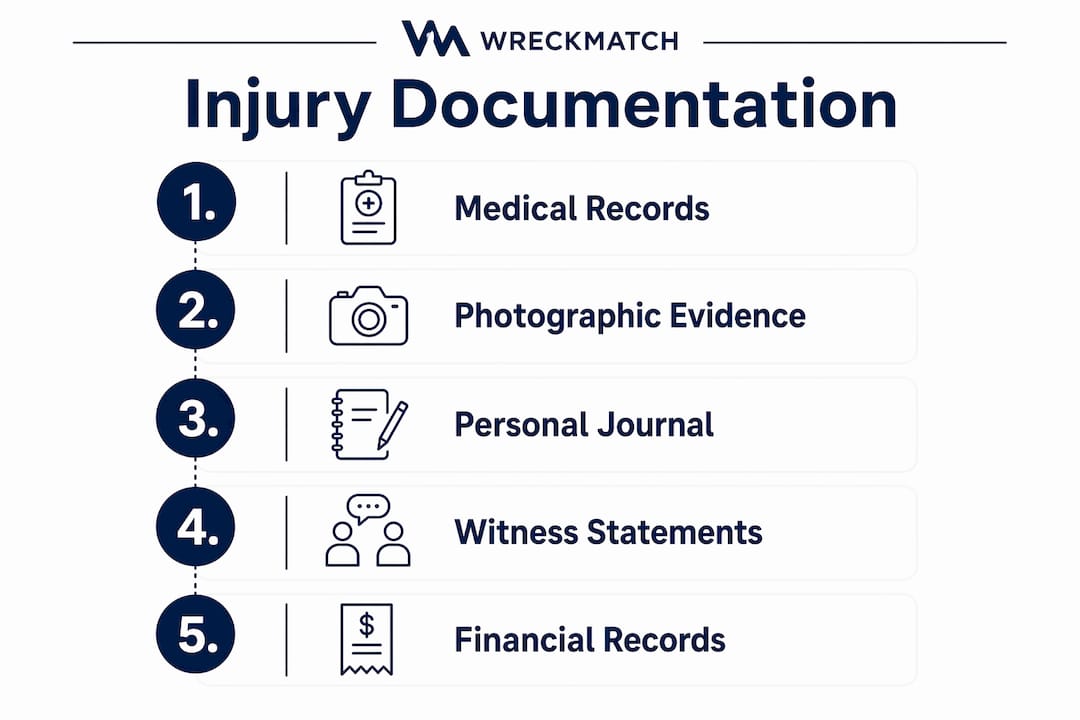
Strong injury documentation pulls from five distinct categories. Each one serves a different purpose, and missing any one of them creates a gap that adjusters will exploit.
1. Medical records
ER reports, diagnostic imaging such as X-rays and MRIs, and physician notes create a timeline that links your injuries to the accident. Medical records scrutinized by insurers for gaps or delays are the first thing an adjuster reviews. Seek medical care the same day as the crash, even if you feel fine.
2. Photographic evidence
Photographs taken immediately from multiple angles with a scale object included provide clear visual evidence for both insurers and courts. A coin or ruler placed next to a bruise gives reviewers an accurate sense of size. Take photos of all visible injuries, vehicle damage, the scene, and road conditions.
3. Personal injury journal
A written journal describing your pain, limitations, and daily impact builds a narrative that medical records alone cannot capture. Record entries every day for at least the first two weeks. Note what you cannot do, how you slept, and any emotional distress.
4. Witness statements and police reports
Collect the names, phone numbers, and email addresses of any witnesses at the scene. Request a copy of the official police report as soon as it is available. These records establish the facts of the incident independently of your own account.
5. Financial records
Keep every receipt, bill, and invoice tied to your treatment. This includes prescriptions, physical therapy, medical equipment, and transportation to appointments. These records form the basis of your economic damages claim.
| Documentation type | Primary purpose |
|---|---|
| Medical records | Prove injury causation and treatment timeline |
| Photographs | Show visible damage and injury progression |
| Personal journal | Capture pain, limitations, and daily impact |
| Witness statements | Corroborate facts of the incident |
| Financial records | Support economic damages calculation |
Pro Tip: Photograph the scene and your injuries before you leave the accident location if you are physically able. Lighting, skid marks, and debris disappear quickly.
How does timing affect your injury documentation?
The timing of your documentation directly affects how credible your claim appears. Early records carry more legal weight than records created days or weeks after the crash. Follow this sequence to protect your claim from the start.
- Within the first hour: Call 911 and request a police report. Take photographs of the scene, vehicles, and any visible injuries before anything is moved or cleaned up.
- Same day: Seek medical evaluation even if symptoms feel minor. Delayed care gives adjusters grounds to argue your injuries were not caused by the accident.
- Within 24 hours: Write a detailed account of the crash while your memory is fresh. Include the time, weather, road conditions, what you felt physically, and any statements made at the scene.
- Days 2 through 7: Re-photograph injuries every 24–48 hours to capture the peak of bruising and swelling. Injuries often look worse on day three or four than on day one. That progression is powerful evidence.
- Ongoing: Attend every follow-up appointment. Keep your journal updated. Save all new bills and correspondence from your insurer.
Missing a step early in this timeline does not end your claim. But each gap gives the opposing side a tool to question your credibility. The steps to document injuries you take in the first 72 hours carry the most weight.
Pro Tip: Set a daily phone alarm for the first week to remind yourself to photograph injuries and update your journal. Consistency is what makes the record convincing.
How do insurance companies and courts use injury documentation?
Insurance adjusters are trained to find inconsistencies. Adjusters look for gaps in treatment or social media contradictions to reduce claim payouts. A single missed appointment, a photo posted on social media showing you active, or a two-week delay in seeking care can be used to argue your injuries were not serious or were not caused by the crash.
Your documentation counters each of those tactics directly. A continuous medical record with no unexplained gaps makes it very difficult for an adjuster to dispute causation. Detailed physician notes that reference the accident date establish the link between the incident and your diagnosis. Financial records show the real cost of your recovery.
"The personal injury recovery system relies on verifiable evidence. Without a comprehensive paper trail, insurance adjusters often minimize or deny claims regardless of injury severity." — lawyerbriefs.com
In legal proceedings, documentation determines credibility. A judge or jury weighs the consistency and completeness of your records against the defense's arguments. Thorough records also give your attorney the tools to negotiate a higher settlement before trial. Attorneys who handle insurance adjuster disputes consistently report that well-documented cases settle faster and for more money than cases with incomplete records.
What are practical tips for thorough injury documentation?
The difference between a strong claim and a weak one often comes down to how well the evidence is organized and maintained. These practices make your documentation harder to challenge.
- Use the OLDCARTS method for your pain journal. OLDCARTS stands for Onset, Location, Duration, Character, Aggravating/Alleviating factors, Radiation, Timing, and Severity. This structured format makes your pain descriptions professional and specific. Attorneys and insurance reviewers take systematic records far more seriously than vague complaints.
- Include a scale object in every injury photo. A coin, ruler, or pen placed next to a bruise or laceration gives reviewers an accurate reference point. Without scale, photos can be dismissed as ambiguous.
- Create one central folder for all records. Use a physical binder or a secure cloud folder such as Google Drive. Store medical records, photos, bills, correspondence, and journal entries in one place. Disorganized records slow down your attorney and create openings for the opposing side.
- Never skip a follow-up appointment. A gap in your treatment timeline signals to adjusters that your injuries were not serious enough to require consistent care. If you must reschedule, do so immediately and keep the documentation.
- Avoid social media during your claim. Adjusters actively monitor public profiles. A single photo or post that contradicts your injury description can be used against you in settlement negotiations or court.
Pro Tip: Ask your doctor to specifically note in their records that your injuries are consistent with a motor vehicle accident. That one sentence directly supports causation in your claim.
Common mistakes that weaken claims include waiting more than 24 hours to seek care, taking only one or two photos, and failing to collect witness contact information at the scene. Reviewing a post-accident checklist immediately after a crash helps you avoid these errors under stress.
Key takeaways
Thorough injury documentation is the single most effective action you can take after an accident to protect your medical care, your legal rights, and your financial recovery.
| Point | Details |
|---|---|
| Start immediately | Document the scene, injuries, and your account within the first hour after the crash. |
| Use all five record types | Combine medical records, photos, a journal, witness statements, and financial records for a complete file. |
| Re-photograph over time | Take new injury photos every 24–48 hours for a week to capture peak bruising and swelling. |
| Apply OLDCARTS for pain | Use this structured method to describe pain systematically and make records harder to dismiss. |
| Close every gap | Attend all follow-up appointments and avoid social media to prevent adjusters from undermining your claim. |
Documentation is the one thing I tell every accident survivor to prioritize
I have worked with enough accident survivors to know that the cases that fall apart almost always share one thing in common: the person waited. They waited to see a doctor. They waited to take photos. They waited to write anything down. By the time they came to us, the window for strong contemporaneous evidence had closed.
Insurance companies are not neutral parties. They have trained adjusters, legal teams, and established tactics for reducing what they pay out. Your documentation is your defense against all of that. A well-kept injury journal, a continuous medical record, and a folder of dated photographs shift the burden back onto the insurer to disprove your claim rather than the other way around.
The stress after a crash is real. You may be in pain, dealing with a damaged vehicle, and managing work and family obligations at the same time. I understand that. But I have seen firsthand how a few hours of careful documentation in the days after an accident can mean the difference between a fair settlement and a denied claim. Prioritize it the same way you would prioritize calling your insurance company. It is that important.
If you are unsure where to start, Wreckmatch has a free accident survival guide that walks you through the process step by step. Use it.
— Scott
Wreckmatch connects you with legal help when documentation alone is not enough
After a crash, you should not have to figure out the legal system on your own.
Wreckmatch matches accident survivors with experienced personal injury attorneys at no upfront cost. Attorneys in the Wreckmatch network work on a contingency fee basis, meaning you pay nothing unless you win. If you are unsure whether your documentation is strong enough, or if an insurer has already pushed back on your claim, get free legal help from an attorney who handles these cases every day. You can also review the accident claim timeline to understand exactly when your documentation matters most during the claims process.
FAQ
Why is injury documentation so important after an accident?
Injury documentation creates objective evidence that links your physical harm to the accident. Without it, insurance adjusters can minimize or deny claims regardless of how serious your injuries are.
When should I start documenting my injuries?
Start within the first hour of the crash. Adrenaline can mask pain, so notes and photos taken immediately are considered more reliable than those created days later.
What is the OLDCARTS method for injury documentation?
OLDCARTS stands for Onset, Location, Duration, Character, Aggravating/Alleviating factors, Radiation, Timing, and Severity. Using this structured method makes your pain descriptions systematic and credible to attorneys and insurers.
How do insurance adjusters use my documentation against me?
Adjusters look for gaps in treatment, missed appointments, and social media posts that contradict your injury claims. A complete, gap-free medical record is your strongest defense against these tactics.
How long should I keep photographing my injuries?
Photograph your injuries every 24–48 hours for at least one week after the accident. Injury progression photos capture peak bruising and swelling, which often appear days after the crash and reflect the true severity of your harm.
Recommended
- Protecting Your Legal Rights After an Accident
- Severe Car Accident Injuries: When to Call a Lawyer (2026) | WreckMatch Blog | WreckMatch
- What to Do After a Car Accident (Step-by-Step) | WreckMatch Blog | WreckMatch
- Catastrophic Injury After a Car Crash — Next Steps (2026) | WreckMatch Blog | WreckMatch