
Accident cases go to trial when the two sides cannot reach a settlement agreement on fault, injury value, or insurance coverage. Most personal injury claims never see a courtroom. The Bureau of Justice Statistics confirms that roughly 3% to 4% of tort cases actually reach a trial verdict. That number tells you something critical: trial is the exception, not the rule. But when it happens, it is almost always because one of three specific breakdowns occurred. Understanding those breakdowns helps you make smarter decisions about your own case.
Why accident cases go to trial: the core reasons
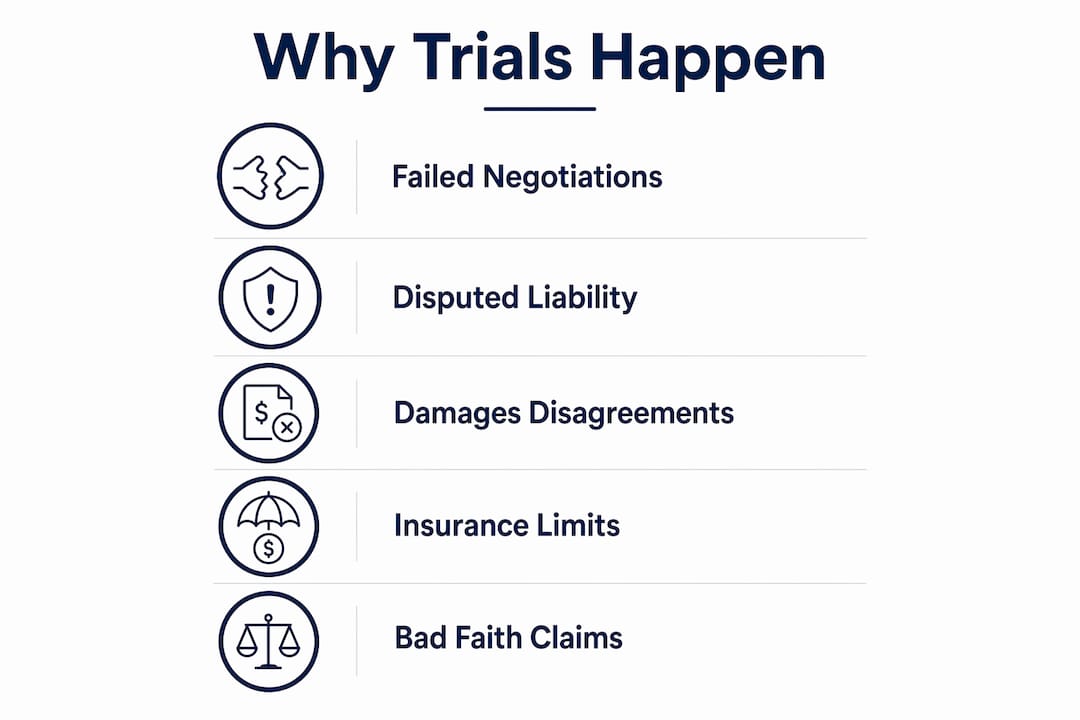
The formal legal term for this process is civil litigation, and it begins when settlement negotiations fail. The American Bar Association recognizes three primary triggers that push accident cases from negotiation tables into courtrooms: disputed liability, disagreements over damages, and insurance coverage conflicts. Each one can independently force a trial, and in complex cases, all three can occur at once.
Disputed liability means the parties cannot agree on who caused the accident. Damages disputes mean they cannot agree on how much the injuries are worth. Coverage conflicts mean the available insurance money does not match what the injured person needs. When any of these gaps cannot be closed through negotiation, a judge or jury must decide instead.
What disputes over fault or liability cause trials in accident cases?
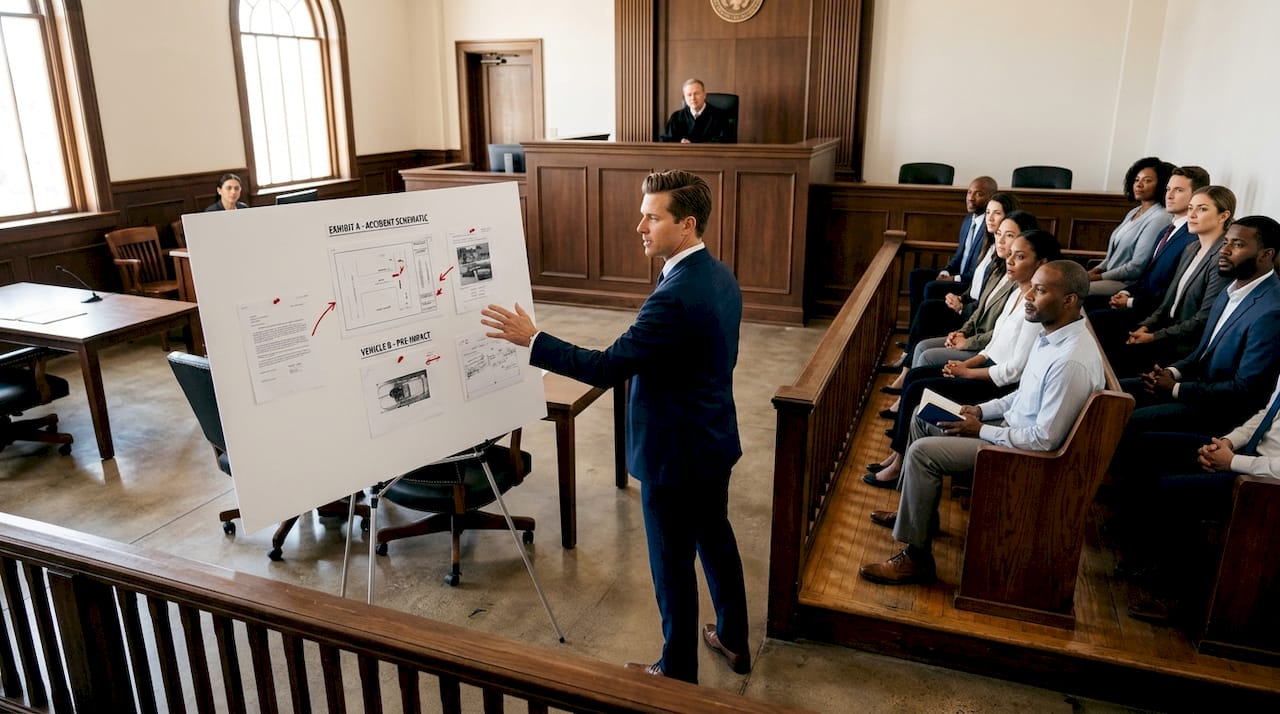
Liability disputes are the single most common reason accident cases proceed to trial. When two drivers tell completely different stories about how a crash happened, no settlement is possible until someone decides who is telling the truth. That job falls to a jury.
Several specific scenarios make liability nearly impossible to resolve outside of court:
- Conflicting witness statements. Two bystanders saw the same crash and gave opposite accounts. Neither side will concede fault when their version has support.
- No clear police report conclusion. Officers sometimes document the scene without assigning blame. That leaves both sides free to argue their version.
- Disputed traffic signal or speed claims. One driver says the light was green. The other says it was red. Without camera footage, this is a direct standoff.
- Multiple liable parties. Commercial vehicle accidents, construction zone crashes, and multi-car pileups often involve finger-pointing on negligence between several defendants. Each party blames another, and no one agrees to pay.
- Accident reconstruction disagreements. Both sides hire experts who analyze skid marks, vehicle damage, and impact angles. When those experts reach opposite conclusions, only a jury can break the tie.
Insurance companies contest liability aggressively because admitting fault opens them to full damages. Their financial incentive is to dispute responsibility whenever the evidence is not airtight.
Pro Tip: If your accident involved a commercial truck, rideshare vehicle, or government-owned car, expect a liability dispute. These cases almost always involve multiple insurers and multiple defense teams, each protecting their own client.
How do disagreements about injury severity and compensation drive accident cases to court?
Even when fault is clear, insurers frequently contest medical or economic damages, causing negotiation breakdowns that lead directly to trial. This is the second major reason why some accidents end in trial. The insurer accepts that their driver caused the crash but refuses to pay what the injuries actually cost.
Common damage disputes that push cases toward a courtroom include:
- Disputed injury causation. The insurer argues your back injury existed before the accident, not because of it. You need medical experts to prove otherwise.
- Disagreement on future medical costs. A spinal cord injury or traumatic brain injury may require decades of treatment. Insurers resist high long-term valuations because the numbers are large and projections are debatable.
- Denial of non-economic damages. Pain and suffering, emotional distress, and loss of enjoyment of life are real losses. Insurers routinely challenge these because no invoice exists to prove them.
- Catastrophic injury claims. Insurance companies dispute high-value claims more aggressively than minor injury cases. The higher the potential payout, the harder they fight.
"Disputed injury causation and valuation frequently hinge on expert testimony and the framing of accident mechanics." This means your attorney's ability to present medical and engineering experts clearly can determine whether your case settles or goes to trial.
The economic impact of these disputes is real. When an insurer offers $40,000 for injuries that will cost $400,000 to treat, no reasonable person accepts that offer. The gap forces litigation. You can learn more about why settlement amounts vary so widely before deciding how to respond to a low offer.
What role do insurance policy limits and company conduct play in forcing trials?
Insurance policy limits create a hard ceiling on what an insurer will pay, regardless of how severe your injuries are. When your damages exceed that ceiling, the insurer has no legal obligation to pay more than the policy allows. That gap between what you need and what the policy covers is a direct path to trial.
| Situation | Likely outcome |
|---|---|
| Damages within policy limits, liability clear | Settlement likely |
| Damages within policy limits, liability disputed | Possible trial |
| Damages exceed policy limits | Trial likely to pursue defendant personally |
| Insurer acts in bad faith | Trial likely, possible bad faith claim added |
Insurance bad faith occurs when an insurer denies a valid claim without reason, makes a lowball offer with no factual basis, or simply refuses to negotiate. Bad faith conduct is a recognized legal trigger for trial. It also opens the insurer to additional penalties beyond the original claim amount. Understanding how insurance adjusters operate helps you recognize bad faith tactics before they derail your case.
When damages exceed available coverage, your attorney may pursue the at-fault driver personally for the difference. That requires a court judgment, which means trial is the only path forward. This strategy, sometimes called "policy-limits economics," shifts the entire litigation approach from negotiation toward legal recovery beyond insurer caps.
Pro Tip: Ask your attorney early whether the at-fault driver carries enough coverage for your injuries. If the answer is no, your attorney needs to investigate whether the driver has personal assets worth pursuing. That decision shapes your entire legal strategy.
How does the legal process work once a case goes to trial?
Understanding the trial process for accidents removes a lot of fear. Here is what actually happens after settlement fails and a lawsuit is filed:
- Filing the lawsuit. Your attorney files a complaint in civil court, formally naming the defendant and stating your claims. The defendant has a set period to respond.
- Discovery phase. Both sides exchange evidence. This includes medical records, accident reports, witness depositions, and expert reports. Many cases settle during discovery once both sides see the full picture. Filing a lawsuit does not guarantee you will ever sit in a courtroom.
- Pretrial motions. Attorneys file motions to exclude certain evidence or dismiss parts of the case. These hearings shape what the jury will and will not hear.
- Jury selection. Both sides question potential jurors and remove those they believe are biased. This process, called voir dire, can take hours or days in complex cases.
- Trial. Each side presents opening statements, witness testimony, and closing arguments. The jury deliberates and returns a verdict.
- Appeals and post-trial outcomes. The losing side may appeal, which adds months or years to the process.
| Trial stage | Typical duration |
|---|---|
| Filing to discovery completion | 6 to 12 months |
| Pretrial motions | 2 to 4 months |
| Trial itself | 3 to 10 days |
| Total filing to verdict | 18 to 24 months |
Trial timelines after filing range roughly 18 to 24 months, with longer durations if appeals occur. That is a significant time commitment compared to a settlement that might resolve in weeks or months. The car accident claim timeline page at WreckMatch breaks down each stage in plain language if you want a clearer picture of what to expect.
Key takeaways
Accident cases go to trial when liability disputes, damages disagreements, or insurance coverage gaps cannot be resolved through negotiation, making judicial resolution the only remaining option.
| Point | Details |
|---|---|
| Trial is rare | Only 3% to 4% of personal injury cases reach a trial verdict; most settle beforehand. |
| Liability disputes drive trials | Conflicting witness accounts, multiple defendants, and expert disagreements make fault impossible to negotiate. |
| Damages gaps force court | When insurer offers fall far below actual injury costs, especially in catastrophic cases, trial becomes necessary. |
| Policy limits create hard ceilings | Damages exceeding coverage require a court judgment to pursue the defendant personally. |
| Trial takes time | From filing to verdict typically runs 18 to 24 months, longer if appeals follow. |
The uncomfortable truth about going to trial
I have spent years working alongside personal injury attorneys and watching accident victims make the trial-versus-settlement decision under enormous pressure. Here is what most articles will not tell you directly.
Trial is almost always a last resort, and that is not a weakness. It is rational. The cost, time, and unpredictability of a jury trial motivate most people to settle unless a fair offer is genuinely impossible. Juries are human. They can be sympathetic or skeptical. They can award more than expected or far less. No attorney, no matter how experienced, can guarantee a jury outcome.
What I have seen consistently is that victims who go to trial with unrealistic expectations suffer twice. First from the accident, then from the emotional grind of two-plus years of litigation. The victims who do well are those who understand the risks clearly before they commit. They work with attorneys who give them honest assessments, not just encouragement.
The misconception I hear most often is that going to trial means you will definitely get more money. Sometimes that is true. Sometimes a jury awards less than the final settlement offer on the table. The right question is not "Will I win more at trial?" The right question is "Is the settlement offer genuinely fair given my injuries and future needs?" A good attorney evaluates that honestly. If yours cannot give you a straight answer, that is a problem worth addressing before you file a lawsuit.
You can compare your options clearly by reading about the lawsuit versus settlement decision before you commit to either path.
— Scott
Get free legal help from WreckMatch
If your accident case is heading toward trial or you are unsure whether to accept a settlement offer, you do not have to figure it out alone.
WreckMatch connects accident victims with experienced personal injury attorneys at no upfront cost. There is no fee unless you win. You can get matched with a licensed attorney in 60 seconds through the WreckMatch free legal help service. If you want to understand every stage of your claim, the Accident Survival Guide covers everything from filing to trial in plain language. For any legal term you encounter along the way, the legal glossary has clear, jargon-free definitions. You deserve real support during a stressful time. WreckMatch was built to provide exactly that.
FAQ
Why do most accident cases settle instead of going to trial?
Settlement is faster, cheaper, and more predictable than trial. Most cases resolve during discovery or pretrial negotiations once both sides understand the full evidence, making a jury verdict unnecessary.
How long does an accident trial take?
From the time a lawsuit is filed to a final verdict, accident trials typically take 18 to 24 months. Appeals can extend that timeline by additional months or years.
What happens if the at-fault driver does not have enough insurance?
When damages exceed the at-fault driver's policy limits, your attorney may pursue a court judgment against the driver personally. This requires going to trial since no insurer will voluntarily pay beyond their coverage cap.
Can a case still settle after a lawsuit is filed?
Yes. Filing a lawsuit does not mean you will go to trial. Many cases settle after discovery narrows the disputed facts, sometimes just days before the scheduled trial date.
What is insurance bad faith and how does it affect trial likelihood?
Insurance bad faith occurs when an insurer denies a valid claim or makes an unreasonably low offer without factual justification. Bad faith conduct significantly increases the chance of trial and can expose the insurer to additional legal penalties beyond the original claim.
Recommended
- Truck Accident Injuries — What Victims Need to Know | WreckMatch Blog | WreckMatch
- Severe Car Accident Injuries: When to Call a Lawyer (2026) | WreckMatch Blog | WreckMatch
- Car Accident vs Semi Truck Claim — Key Differences (2026) | WreckMatch Blog | WreckMatch
- Car Accident Lawsuit Versus Settlement Explained