
Accident victims avoid attorneys primarily because of fear of upfront costs, distrust of the legal system, and emotional overwhelm after a traumatic event. These are not irrational responses. They are predictable reactions to a stressful situation made worse by misinformation from insurers and cultural myths about personal injury claims. Understanding why accident victims reject lawyers is the first step toward making a smarter decision about your own recovery. This article breaks down each barrier clearly, so you can decide whether legal help is right for you.
Why accident victims avoid attorneys: the core reasons
The three most common reasons accident victims reject lawyers are cost fear, distrust, and confusion about the legal process. Each one is understandable. None of them are accurate reasons to go without representation.
Research from LexisNexis shows that 75% of claimants who reluctantly hired an attorney cited their negative initial contact with a third-party insurance carrier as the primary reason they eventually sought legal counsel. That number tells you something important: most victims do not start out wanting a lawyer. They start out trusting the insurance company, and that trust gets broken.

The insurance industry has spent decades promoting the idea that most injury claims are frivolous or exaggerated. That messaging works. It makes real victims feel embarrassed or uncertain about pursuing what they are legally owed. Add in the stress of physical pain, medical bills, and missed work, and it becomes easy to understand why so many people simply do nothing.
Does the contingency fee model remove the cost barrier?
The contingency fee model is the standard payment structure for personal injury attorneys in the United States. Under this model, attorneys only get paid if they win your case. You pay nothing upfront. If there is no settlement or verdict in your favor, you owe the attorney nothing.
This structure exists specifically to make legal help accessible to people who cannot afford hourly rates. Yet fear of lawyer fees remains one of the top reasons accident victims avoid attorneys. The gap between reality and perception is significant.
Here is what the contingency fee model actually means for you:
- No upfront payment. You do not write a check to start your case.
- No out-of-pocket risk. If the case does not settle, you do not owe attorney fees.
- Aligned incentives. Your attorney only earns money when you do. That makes them a partner in your recovery, not a vendor charging by the hour.
- Access regardless of income. A victim earning minimum wage has the same access to a personal injury attorney as someone earning six figures.
The typical contingency fee in personal injury cases ranges from 33% to 40% of the final settlement. That percentage sounds large until you compare it to what unrepresented victims typically receive. Studies consistently show that represented claimants recover significantly more, even after attorney fees are deducted.
Pro Tip: Ask any attorney you consult about their exact fee percentage and whether case costs like filing fees or expert witnesses are deducted before or after the attorney's cut. This one question can save you thousands of dollars.
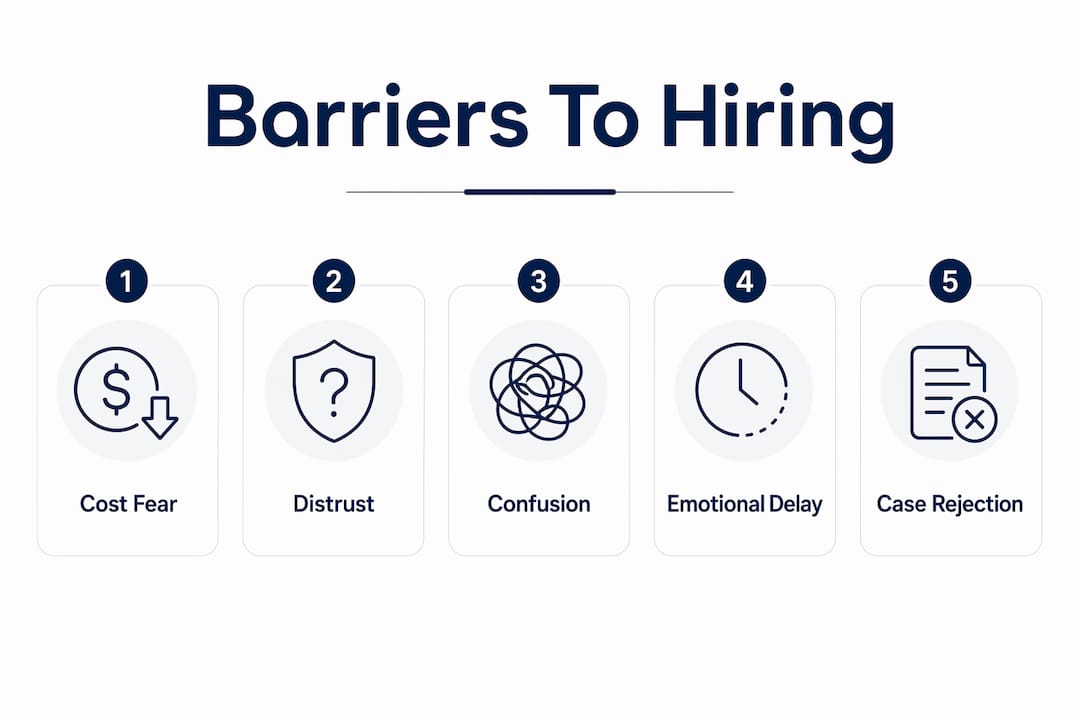
If you are worried about upfront legal costs, the contingency model is specifically designed to address that concern. Cost alone is not a valid reason to avoid legal help after an accident.
How does distrust of attorneys and insurers affect victim decisions?
Distrust is one of the most powerful forces driving confusion about legal representation. It comes from two directions at once: victims distrust attorneys because of cultural stereotypes, and they distrust insurers after being misled or ignored.
The LexisNexis data shows that 71% of claimants had to make the first call to their insurance carrier themselves. That means the insurer did not reach out proactively. When victims finally do connect with an adjuster, they are often told their claim is simple, their injuries are minor, or that a lawyer would just complicate things. That advice benefits the insurer, not you.
Corporate messaging about a "lawsuit crisis" is a deliberate tactic to discourage legitimate claims. It is not a neutral public health warning. It is a strategy designed to reduce payouts.
Here is how to identify a trustworthy personal injury attorney before you commit:
- Ask how they communicate. Will they call you back within 24 hours? Do they assign a case manager?
- Ask about their case volume. An attorney handling 500 cases at once may not give yours the attention it needs.
- Ask for references or reviews. Google reviews and Avvo ratings are imperfect but useful starting points.
- Ask what happens if they decline your case. A good attorney will tell you why and may refer you elsewhere.
Legal experts consistently describe attorneys as recovery partners, not adversaries pushing litigation. Their job is to handle paperwork, negotiate with insurers, and protect your rights while you focus on healing. That framing matters. You are not hiring someone to fight. You are hiring someone to manage a process you should not have to manage alone while injured.
Pro Tip: Before signing with any attorney, ask directly: "Have you handled cases similar to mine, and what were the outcomes?" A confident attorney will answer clearly. Vague or evasive answers are a red flag.
If you are unsure how to handle early insurer contact, read Wreckmatch's guide on talking to insurance adjusters before your next call.
Why do emotional and cognitive factors delay legal action?
Trauma reduces your ability to make good decisions. This is not a character flaw. It is biology. After a serious accident, victims' mental bandwidth is severely reduced by pain, medication, and financial anxiety. That cognitive overload leads directly to delayed or avoided legal decision-making.
Most victims focus on medical recovery first. That is the right instinct. But avoiding legal complications after accidents for too long creates real, irreversible problems. Here is what happens when you wait:
- Evidence disappears. Skid marks fade. Surveillance footage gets overwritten. Witnesses forget details. The longer you wait, the weaker your physical evidence becomes.
- Statutes of limitations expire. Most states give you 2–3 years to file a personal injury claim. Miss that deadline and your case is gone, regardless of how strong it was.
- Medical records become harder to connect. Gaps between your accident date and your first medical visit give insurers ammunition to argue your injuries were not caused by the crash.
- Insurers gain leverage. The longer you wait without representation, the more time adjusters have to build a case for a low settlement.
Delays in consulting lawyers risk missing filing deadlines and losing critical evidence. You do not need to have everything figured out before you call an attorney. Lawyers primarily build cases using rough timelines and basic medical information. You do not need a perfect file to start.
The practical advice here is simple: contact an attorney within the first two weeks after your accident, even if you are still in treatment. A free consultation costs you nothing and protects your options.
With vs. without an attorney: what are the real risks?
One of the most persistent misconceptions about personal injury attorneys is that you only need one for catastrophic injuries. That belief causes real financial harm to people with moderate injuries who walk away with far less than they deserve.
Common barriers deterring victims include the belief that only major injuries require lawyers and the assumption that insurance companies are neutral parties. Neither is true. Insurers are for-profit companies. Their adjusters are trained to minimize payouts.
| Factor | With an Attorney | Without an Attorney |
|---|---|---|
| Settlement amount | Typically higher, even after fees | Often lower due to missed damages |
| Hidden injury coverage | Attorney identifies delayed complications | Victim may settle before symptoms appear |
| Deadline management | Attorney tracks all filing deadlines | Victim risks missing statutes of limitations |
| Insurer negotiation | Attorney handles all communications | Victim negotiates directly, often at a disadvantage |
| Paperwork and documentation | Managed by legal team | Victim responsible for all filings |
| Stress level during recovery | Reduced, attorney manages process | Higher, victim handles legal and medical simultaneously |
Even in moderate cases, an attorney can identify damages you did not know you could claim. Lost wages, future medical costs, pain and suffering, and property damage are all recoverable in most states. Unrepresented victims routinely leave these categories on the table.
Can accident victims represent themselves? Technically, yes. Practically, it costs most of them money.
Why do some attorneys decline cases, and what does that mean for you?
When an attorney declines your case, it feels like rejection. For many victims, it confirms their fear that their injury is not serious enough or that no one will help them. That interpretation is usually wrong.
Attorneys use contingency fees as a risk management tool. They only accept cases with sufficient damages, clear liability, and a collectible defendant. This is a business reality, not a judgment about you as a person.
Common reasons an attorney may decline your case:
- Low damages. Cases with under approximately $5,000 in damages often do not generate enough in fees to cover the attorney's overhead and time.
- Unclear liability. If fault is genuinely disputed and hard to prove, the case becomes expensive and uncertain.
- No collectible source. Even with clear liability and serious injuries, a case is often declined if the at-fault party has no insurance and no assets to collect from.
- Missed deadlines. If the statute of limitations has expired, no attorney can help you.
If one attorney declines, contact another. Different firms have different thresholds and specialties. You can also explore community legal aid options if your damages are modest but your need is real.
The key takeaway: a declined case is information, not a verdict. Use it to understand your situation better and keep looking.
Key takeaways
Accident victims who understand the real barriers to hiring attorneys are far better positioned to protect their rights, meet critical deadlines, and recover fair compensation.
| Point | Details |
|---|---|
| Cost fear is a myth | Personal injury attorneys work on contingency, meaning no upfront payment is required. |
| Insurer distrust drives decisions | 75% of victims who hired attorneys cited negative insurer contact as the trigger. |
| Delays destroy cases | Waiting too long risks losing evidence and missing statutes of limitations. |
| Minor injuries still need legal review | Attorneys identify hidden damages that unrepresented victims routinely miss. |
| Declined cases have specific reasons | Low damages, unclear liability, or no collectible source are business decisions, not personal rejections. |
What i've learned about why victims stay away from legal help
I have spent years working at the intersection of accident victims and the legal system. The pattern I see most often is not greed or laziness. It is fear layered on top of exhaustion.
Most people who avoid attorneys after an accident are not making a calculated decision. They are overwhelmed, in pain, and operating on the assumption that the system is not built for them. That assumption is reinforced every time an insurance adjuster tells them their claim is simple or that a lawyer would just complicate things.
What I find genuinely frustrating is how preventable most of these outcomes are. The contingency fee model exists precisely to remove financial barriers. Free consultations exist so you can evaluate an attorney without committing. And yet the myths persist because they benefit the parties with the most money and the loudest voices.
The victims I have seen recover the best outcomes share one trait: they asked for help early, even when they were not sure they needed it. They did not wait for a perfect moment or a perfect file. They made one call while they were still in recovery, and that call protected everything that came after.
If you are reading this and you are still on the fence, treat a free consultation the same way you would treat a second opinion from a doctor. You are not committing to anything. You are just getting information. That information might be the most valuable thing you do this month.
— Scott
Get free attorney matching with Wreckmatch
After an accident, you should not have to figure out the legal system alone. Wreckmatch connects injured people with experienced personal injury attorneys at no cost and with no upfront commitment. The process takes about 60 seconds. You describe your situation, and Wreckmatch matches you with a licensed attorney who handles cases like yours.
If cost, trust, or confusion has been holding you back, start with Wreckmatch's free accident help resources to understand your options before you make any decisions. You can also join a free weekly webinar to ask questions in real time. Get the information you need at WreckMatch.com today.
FAQ
Do personal injury attorneys charge upfront fees?
No. Personal injury attorneys work on a contingency fee basis, meaning they only get paid if you win your case. You owe nothing upfront and nothing out of pocket if the case does not settle.
How long do i have to file a personal injury claim?
Most states set a statute of limitations of 2–3 years from the date of the accident. Missing this deadline eliminates your right to file, regardless of how strong your case is.
Should i talk to an attorney before the insurance adjuster?
Yes. Speaking with an attorney first gives you a clear picture of your rights before an adjuster tries to minimize your claim. Wreckmatch's guide on adjuster interactions explains exactly what to expect.
What if my injury seems minor? do i still need a lawyer?
Minor injuries can develop into serious conditions weeks after an accident. An attorney can identify delayed complications and recoverable damages you may not know to claim, including lost wages and future medical costs.
Why would an attorney decline my case?
Attorneys on contingency only accept cases with sufficient damages, clear liability, and a collectible defendant. A declined case reflects business criteria, not the validity of your experience. Contacting multiple attorneys or exploring legal aid options is the right next step.